

Tourists in Anapa have faced calls to leave the beaches as the season opens.
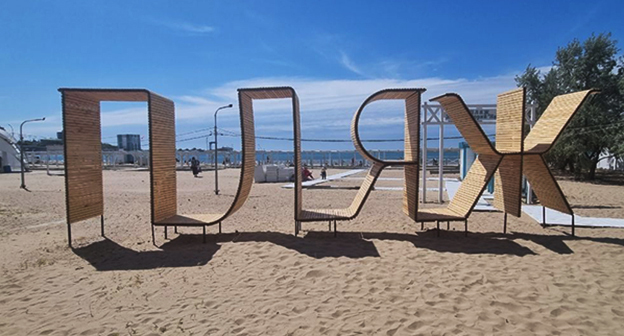
Tourists are urged to leave Anapa beaches, where new sand is still being added. 4.5 kilometers of beaches are open to visitors. The quality of imported sand is worse than that of dune sand; the new sand resembles clay, tourists noted.
As reported by "Caucasian Knot," the Kuban office of Rospotrebnadzor stated that water samples and areas where new sand has been added meet the required standards for petroleum product content, unlike at the Anapa beach, where imported sand has not yet been added. The swimming season in Anapa officially opens on June 1 and runs until September 30. Permission for swimming in the sea will be valid in areas excluded from the danger zone designated after the tanker emergency. Social media users have expressed concerns about the safety of the water and sand. On May 28, authorities reported that imported sand would be sifted and dried on the beaches. However, Telegram users believe that it will be impossible to recreate quartz sand. Activists are concerned that the quality of the sand being used to fill Anapa's beaches is strikingly different from the dune sand. This could ruin the city's reputation as a resort, activists believe. Authorities reported that over 136,000 cubic meters of sand have been delivered to Anapa's beaches, and over five kilometers of shoreline have already been filled. New sand hardens after rain and turns into a suspension in water, Telegram users reported.
Anapa residents and visitors are asked to avoid beaches where sand is being filled and leveled. This is unsafe and hampers the operation of heavy vehicles, the Anapa mayor's office announced today. Restoration work is currently underway on the second section, with equipment operating from the beach near Neftyanik Kubani to Dzhemetinsky Proezd. For now, use is permitted on beaches excluded from the danger zone – this includes 3.5 km of sandy beaches from Lechebnoye to the Bimlyuk sanatorium and 1 km of beach area in Vityazevo, as well as all pebble beaches. Travel on the remaining beaches is currently prohibited. We ask for your understanding regarding these temporary restrictions.
On June 2, JSC "Anapa Resorts" reported that mechanized leveling and double screening had been completed. The imported sand extends all the way to Moreleto Beach. "The sifted sand is transformed before our eyes after our equipment has been working," the statement reads.
Blogger Yuri Ozarovsky posted a video of cars driving around the beach in Dzhemete, urging vacationers to leave.
Tourists noted that the new sand is of a different quality.
"We were swimming at the Central Beach. One day, someone came up to us and said they would be loosening the sand and asked us to leave. So, in that regard, everything is organized. But I kept saying throughout my vacation that the new sand is different from the Anapa sand. It's different in texture, feel, and shine. The clay makes white clothes turn yellow. The kids spill a little water on it, and everything is covered in clay. "And the native sand dried out much faster after the rains... Maybe it's justified... Yesterday there were still rocks on the Central Beach, and today, look, everything's already been cleaned," 93.ru quotes tourists from St. Petersburg, Elena and Inna, as saying.
"Everyone's hoping that this sand will be washed away during the winter storms. For now, it's important to open the beaches and get the season started," commented blogger Andrey Makovozov.
A married couple from Krasnodar reported their disappointment with their vacation in Vityazevo. "We were told the beach was ready for guests, the information was on the hotel's website, but that's not true. We also looked at the information on official government channels... And in the end, we were wearing sneakers with black soles. So, we took off our sneakers, went out, everything seemed clean, but when we came back, there were black spots on our feet. Last summer, we came to Anapa for a vacation, but we went there taking all the risks ourselves. And now, it seems, the authorities are saying, "Come and swim here," and we arrive and see this. "That is, even in the open area in Vityazevo, we just saw healthy chunks of clay," Ilya and Elena are quoted as saying in the publication.
Materials on the consequences of the fuel oil spills in the Kerch Strait and Tuapse have been collected by the "Caucasian Knot" on the page "Eco-disaster in Kuban." Data on the scale of coastal pollution has been collected by the "Caucasian Knot" in the reference material "Fuel Oil Spill in the Kerch Strait".
We have updated the applications on href="https://play.google.com/store/apps/details?id=ru.sambino.ionic&hl=ru">Android and IOS! We would be grateful for criticism and development ideas both in Google Play/App Store and on KU pages in social networks. Without installing a VPN, you can read us in Telegram (in Dagestan, Chechnya and Ingushetia – with VPN). Using VPN, you can continue reading "Caucasian Knot" on the website as usual, and on social networks: Facebook*, Instagram*, "VKontakte", "Odnoklassniki" and X. You can watch "Caucasian Knot" videos on YouTube. Send messages on WhatsApp* to +49 157 72317856, on Telegram to the same number, or write to @Caucasian_Knot.
* Meta (owner of Facebook, Instagram, and WhatsApp) is banned in Russia.
Translated automatically via OpenAI from https://www.kavkaz-uzel.eu/articles/423795




![Tumso Abdurakhmanov. Screenshot from video posted by Abu-Saddam Shishani [LIVE] http://www.youtube.com/watch?v=mIR3s7AB0Uw](/system/uploads/article_image/image/0001/18460/main_image_Tumso.jpg "Tumso Abdurakhmanov. Screenshot from video posted by Abu-Saddam Shishani [LIVE] http://www.youtube.com/watch?v=mIR3s7AB0Uw")