


Lawyers assessed the legality of the refusal to send Ziyavudin Ashikov to the Special Military District.
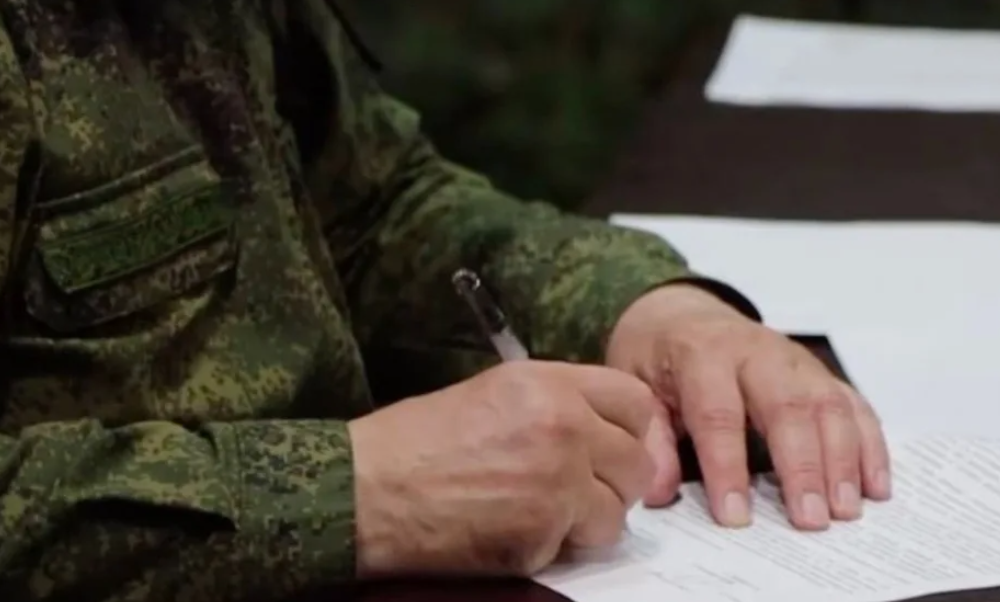
The law does not require a contract to be signed with every prisoner who expresses a desire to be sent to a military operation zone. In Dagestan, selectivity in granting such an opportunity may be corrupt, lawyers emphasized, commenting on reports of numerous refusals to send the former acting head of the Kaspiysk police department, Ziyavudin Ashikov, to the SVO zone.
As reported by "Caucasian Knot," the former acting head of the Kaspiysk police department, Ziyavudin Ashikov, convicted of financing terrorism and attempting to assassinate a security official, requested three times to be sent to the combat zone in Ukraine and was refused three times.
Former Makhachkala police chief Raip Ashikov and his brother, former acting head of the Kaspiysk police department Ziyavudin Ashikov, were accused of financing terrorism and attempting to assassinate a security official. Raip Ashikov was also suspected of abuse of power in December 2020. In September 2023, a court in Rostov-on-Don sentenced Raip Ashikov to 14 years in prison, and Ziyavudin Ashikov to 12 years and six months. Raip Ashikov maintained his innocence and claimed that his problems began after a conflict with a high-ranking official. Relatives of the Ashikovs and their co-defendant, Omar Abdurashidov, have repeatedly held protests, insisting that the case is fabricated. According to Ashikov's relatives, he became involved in the criminal case after uncovering multibillion-dollar embezzlement during an investigation into the Dagestani branch of Rosselkhozbank. In October 2020, the ECHR communicated Raip Ashikov's complaint regarding his unjustified detention and the continued extension of his pre-trial detention.
Colonel Ziyavudin Ashikov did not complain of a violation of his rights or pressure during a meeting with representatives of the Public Monitoring Commission (PMC) of Dagestan, who visited Pre-trial Detention Center No. 1 in Makhachkala on February 19, the head of the PMC of Dagestan, Shamil Khadulaev, told a Caucasian Knot correspondent.
"The report will be sent this week." "But he had no complaints about anything, no complaints about rights violations, detention conditions, health, and so on; everything in that regard was normal. The only complaint he had was that they weren't taking him to the special military unit," he said.
At the same time, the reason why Ashikov is being held in Pretrial Detention Center No. 1 and not in a penal colony is unclear. "We honestly haven't looked into it, but we know he's been in prison for almost seven years now." "He said he was tired of sitting there and wanted to go to the SVO," Khadulaev noted.
According to him, judging by the stories of people held in Pretrial Detention Center No. 1, it's a fairly common practice for people who want to be released from custody to the SVO.
"They named three or four people who are also not being released to the SVO, even though the laws allow them to. "They don't explain the reasons for the refusal, just a refusal and that's it," Khadulaev said.
There is no obligation to sign a contract with them if they wish to do so.
Lawyer Patimat Abdullayeva pointed out that the pretrial detention center is not obligated to release prisoners to the temporary confinement facility.
"People are even detained so that they sign contracts and go to the temporary confinement facility. If these people request release and are refused, from a legal standpoint, there are no violations. Nowhere in the law is it stipulated that their requests must be granted. They can easily be refused. There is no obligation to sign a contract with them if they wish to do so. The principle of individualization of punishment is enshrined in law, but unfortunately, for the same reasons, some people may be given a suspended sentence, while others may be sentenced to pretrial detention," she told a "Caucasian Knot" correspondent.
In her opinion, the reason for the refusals is most likely personal.
"It seems they are angry with them. "Most likely, these are wealthy people, and they may not admit guilt, did not cooperate with the investigation, or have embittered someone for some reason," she said.
The lawyer suggested that the basis for the refusal could be cases where wealthy people under criminal prosecution are sent to the special military unit, but "they are not actually in the hot zone, they are sitting it out somewhere and even buying awards."
In Russia, laws and equality no longer apply, this is how Interior Ministry Colonel and PhD candidate Amir Kolov explains the refusal to send officials from Dagestan to the special military unit.
"That is why we often observe discrimination against citizens' rights by government agencies based on their origin or based on selfish, corrupt interests certain individuals or, as some officials justify themselves, for political expediency. The fact that in Dagestan there is a gradation between officials and ordinary citizens who have committed crimes in matters concerning sending to the SVO may be due to the fact that there are quite a lot of representatives of the common people from Dagestan among the SVO participants, so there is no need to send additional forces there, while officials who have embezzled and committed official crimes are in demand by the special services in order to obtain information from them about the corrupt activities of government agencies in general and incriminating evidence against individual officials,” he told a “Caucasian Knot” correspondent.
According to him, wealthy officials who have ended up behind bars must “pay” for being sent to the SVO zone. According to rumors among those in power, sending officials who have discredited themselves in the service of the state to the SVO also requires a separate fee. Some tainted officials manage to go to the SVO even before the start of criminal prosecution,” he noted.
Translated automatically via OpenAI from https://www.kavkaz-uzel.eu/articles/421121

![Tumso Abdurakhmanov. Screenshot from video posted by Abu-Saddam Shishani [LIVE] http://www.youtube.com/watch?v=mIR3s7AB0Uw](/system/uploads/article_image/image/0001/18460/main_image_Tumso.jpg "Tumso Abdurakhmanov. Screenshot from video posted by Abu-Saddam Shishani [LIVE] http://www.youtube.com/watch?v=mIR3s7AB0Uw")