

The discussion about the reasons for the exodus of the Armenian population of Karabakh unfolded on social media.
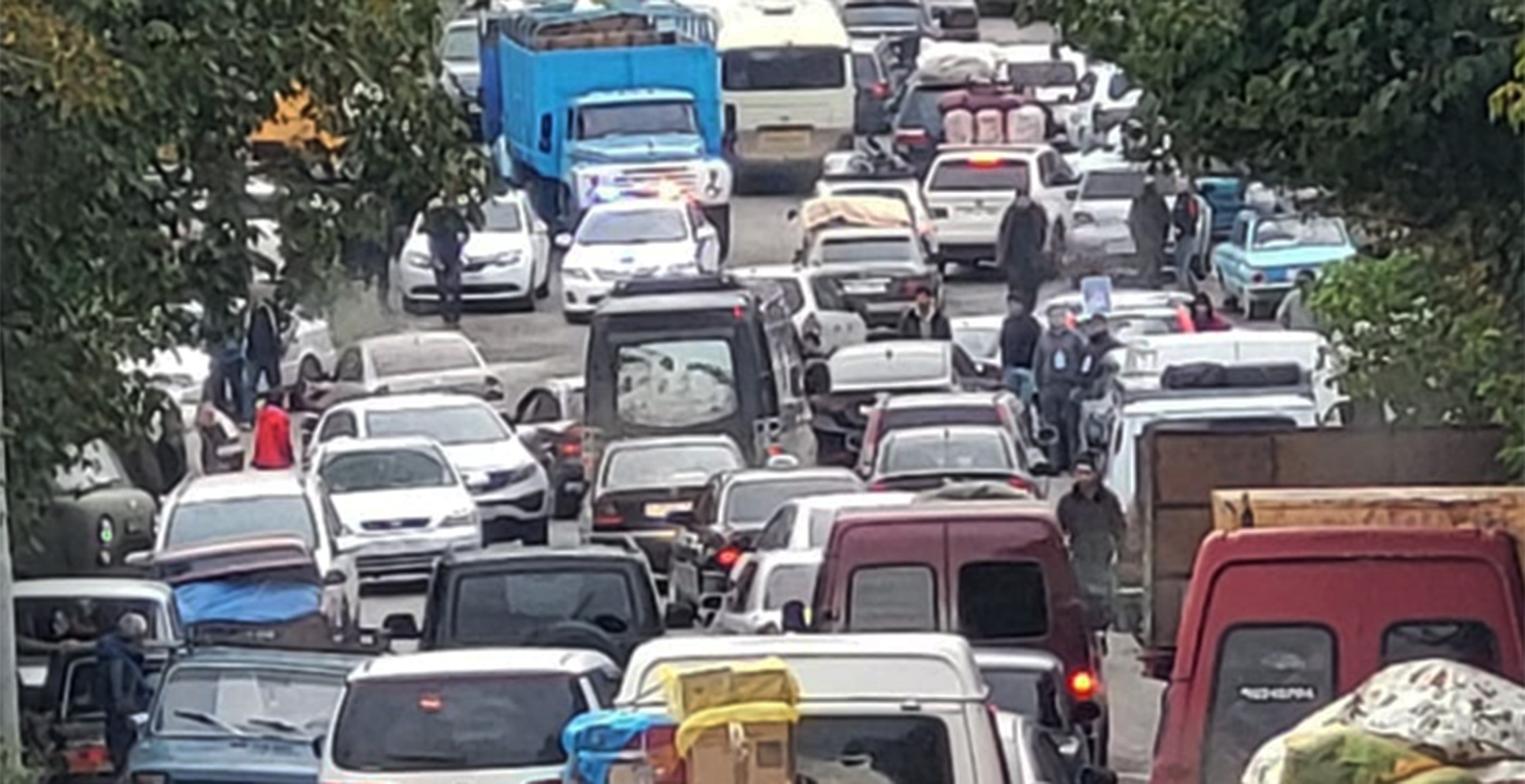
The Armenian population of Karabakh was forced to leave their homes, a number of social media users indicated. Their opponents believe that the mass resettlement to Armenia was voluntary. Despite the measures ordered by the International Court of Justice in the case of "Armenia v. Azerbaijan" regarding protective measures and the right of refugees to return, similar rulings have not led to real results, and the court itself lacks a mechanism for enforcing its decisions.
As reported by "Caucasian Knot", on September 22, in Khankendi (Armenian name - Stepanakert), as well as in the Khojaly, Agdere, and Jebrail regions, 284 people returned - 59 families who left the region during the Karabakh conflict.
Azerbaijan's military operation in 2023 forced residents to leave Karabakh, so they have the right to return, some social media users stated. Other commentators argued that the residents left voluntarily, and their return is only possible if they accept Azerbaijani citizenship. On September 19-20, 2023, Azerbaijan conducted a military operation in Nagorno-Karabakh. On September 20, 2023, an agreement was reached to cease hostilities and disarm the Defense Army of Nagorno-Karabakh. Azerbaijani President Ilham Aliyev announced that all objectives of the operation had been achieved. After that, the exodus of residents from Nagorno-Karabakh began. More details about the events of September 19-20, 2023, can be found in the report "Caucasian Knot" Karabakh: escalation of the conflict or a new war?.
Publications about the return of 59 Azerbaijani families to Karabakh and the discussion about who has the right to return to Karabakh gathered more than 1,500 comments on the "Caucasian Knot" page on Facebook.
The discussion about the return of families to Karabakh is focused on several topics: restoration of the territory, the right to return, the fate of people who left their homes. Along with support for the return, the comments continue to debate the reasons for the population's exodus and the conditions for further living in the region.
Azerbaijani users welcomed the news of resettlement to Karabakh
For some participants in the discussion, the return is perceived primarily as an opportunity to live again where their former homes were.
"Temporary difficulties may occur, but the main thing is that they are on their native land. Wishing them happiness and prosperity in their homes!" - believes Dilara Kulieva, welcoming the return of families of those who previously lived in Karabakh.
Happy for everyone returning to their ancestral lands
"Super, happy for everyone returning to their ancestral lands," noted Fatima Djafarova.
Several comments view the return of 59 families not as a separate event, but as one stage of a large-scale resettlement and restoration process.
"The return of 59 families to Karabakh is one of the real results of the Great Return process. It is a very pleasant event when families return to their homeland," wrote Gulnara Sharifova.
Azerbaijan continued the resettlement of residents to the territories that came under Baku's control. The authorities planned to return up to 34,500 families, or 140,000 people, by the end of 2026 as part of the first phase of the "Great Return" program. Analysts pointed out that the pace of resettlement is hindered by the mine danger, lack of jobs, and unresolved land use issues. Returning residents noted improvements in living conditions and infrastructure, but employment issues persisted.
"It is a very important historical event that people are returning to their lands and building a new life after many years," she noted.
"Living all these years in hope of one day returning Home! And here is this return!" - wrote Sabina Malikova.
How long will it take to restore
The discussion also mentioned the pace of restoration. "Does anyone think that a territory of 10,000 square kilometers, completely destroyed, can be fully restored in 6 years and super conditions created there?" - wrote Leyla Tan.
The conditions for the return of the Armenian population sparked debates
One of the main contentious issues is why residents left Karabakh. The comments present mutually exclusive explanations.
"No one chased you away, you packed your <
"In one day, not everyone could leave voluntarily, and everyone knows this," countered Karen Andreasyan.
The debate about the return quickly shifts to the question of who exactly has such a right. The comments juxtapose the rights of former residents of Karabakh and Azerbaijanis who left their homes as a result of previous stages of the conflict.
Return can happen on one condition, you forget the word Artsakh (the self-name of Nagorno-Karabakh - note from "Caucasian Knot") Accept our citizenship
"It would be good if Azerbaijani refugees returned," expressed Qadji Quseynov.
Some participants suggest considering the return of the population as a mutual process, extending this demand to people who left the territory of modern Armenia.
"This is possible, but Azerbaijanis who were expelled should also return to their villages and homes," noted Adil Baxshaliev.
Another question concerns the conditions under which residents could return and stay in the region.
"Return can happen on one condition, you forget the word Artsakh (the self-name of Nagorno-Karabakh - note from "Caucasian Knot") Accept our citizenship," wrote R.G. Zlraddinoglu.
"Live by our laws," added Faik Bakinetz.
Some Artsakh residents wanted to stay and accept this citizenship. What is their fate?
The question of how the returning and remaining residents will live becomes a continuation of the debate about the return.
"Only with Azerbaijani passports," wrote Ahmed Mir Bagirov.
"Some Artsakh residents wanted to stay and accept this citizenship. What is their fate? Only honestly," asked Ruslan Agaev.
The number of Armenian refugees from Nagorno-Karabakh was estimated by the UN as of October 1, 2023, at more than 100,000 people. By October 7, 2023, 100,632 displaced persons from Nagorno-Karabakh arrived in Armenia. By the beginning of September 2024, 14 Armenians remained in the region; one of the last Armenian residents of Karabakh, 70-year-old Vera Agasyan, died at the end of October 2024. On January 3, the Minister of Labor and Social Affairs of the Republic of Armenia, Arsen Torosyan, reported that 11 people who remained there after the exodus of the population of Nagorno-Karabakh - 10 ethnic Armenians and one Russian with Armenian citizenship - were resettled in Armenia.
Despite the overall contentious nature of the discussion, some users speak of the need to end the confrontation and restore peaceful life.
"Let there be peace on this land from now on! Enough blood and suffering!" - wrote Sabina Malikova.
"Wars are tears, suffering, the cries of mothers burying their children," she noted.
UN International Court decisions have not yet led to the real return of refugees
"Caucasian Knot" requested AI to analyze the enforcement of the International Court of Justice's decisions regarding the safe return of residents who left the territory after hostilities.
On November 17, 2023, the International Court of Justice obliged Azerbaijan to ensure that residents who left Karabakh after September 19 and wish to return could do so safely, without obstacles, and as soon as possible, and to preserve documents related to their registration and property. Official Baku welcomed the decision and stated that the measures provided by the court correspond to the declared policy of the authorities regarding the residents of the region.
Legally, the protective measures in the case of Armenia v. Azerbaijan are not just a political recommendation. The court separately confirmed that its protective measures under Article 41 of the Statute have binding force and create international legal obligations for the addressee. But this is not yet a final decision on the merits of the dispute, but a protective measure in effect until a final decision is made, as follows from the analysis conducted by Chat GPT.
A similar case occurred in 2008 when Georgia appealed to the International Court after an armed conflict with Russia and demanded to protect the right of ethnic Georgians to return to South Ossetia and Abkhazia.
Georgia asked the Court to compel Russia to ensure the rapid and effective return of internally displaced persons in safe conditions. The Court did indeed take protective measures on October 15, 2008. They concerned, in particular, preventing discrimination, violence, forced displacement, and actions obstructing the return of displaced persons. However, the case of Georgia v. Russia did not reach consideration on the merits. In 2011, the Court dismissed the case at the preliminary objections stage.
Another close example is Croatia and Serbian refugees. In the case of Croatia v. Serbia, the issue of the return of the Serbian population after the war was also directly related to the consideration of the International Court. Serbia, in particular, demanded to establish legal conditions and ensure the safe and free return of Serbs to their places of residence in Croatia. However, in the final decision of 2015, the Court did not establish violations of the Genocide Convention that would entail a corresponding order for return. The Court recognized the existence of acts related to the expulsion and harm to the Serbian population but concluded that there was no proven specific intent to destroy the group as such.
The International Court itself does not have a mechanism that could open the border or physically ensure the return of people. In case of non-compliance with the final decision, an additional mechanism becomes an appeal to the Security Council.
There are no sustainable precedents for the enforcement of such decisions by the UN Court, and this specific ruling on Karabakh has also not been implemented in a substantive sense, as stated in the analysis conducted at the request of "Caucasian Knot" by Claude.ai.
The structural reason for non-implementation is that the UN Court does not have its own enforcement mechanism. A final decision may take years, and the UN Court has no way to enforce its decisions. Formally, the enforcement of the Court's decisions is ensured by Article 94 of the UN Charter - through an appeal to the UN Security Council, which can "decide on measures" in case of non-compliance. But this mechanism almost never works in practice: the decision is made by the Security Council, where permanent members have veto power, so there have been virtually no real cases of enforcement through the UN Security Council for non-compliance with UN Court decisions.
In addition to the issue of the right of refugees to return in the case of Georgia v. Russia, which was terminated in 2011, the analysis provides several other similar examples.
In the case of Qatar v. UAE in 2018, temporary measures were adopted regarding family/student reunification. There was no formal "enforcement of the court's decision" - the case was terminated in 2021 after a political settlement (reconciliation of Gulf countries), not as a result of judicial enforcement.
In the case of Gambia v. Myanmar in 2020, it was prescribed to prevent actions forcing Rohingya to leave the country. Organized return of Rohingya refugees from Bangladesh has not yet occurred; the case is also under consideration on the merits.
In the case of the Democratic Republic of the Congo v. Uganda, a decision on reparations was made in 2022 - this is a rare example of at least partial enforcement: Uganda agreed to pay compensation ($325 million) in installments, including for damage to displaced persons, but this is monetary compensation, not the physical return of the population.
There are virtually no precedents for the complete and forced enforcement of UN Court decisions regarding the safe physical return of the population to their former territory after military actions. Usually, such temporary measures either remain declarative (as in the Karabakh case) or the issue is resolved through political settlement of the parties, not judicial enforcement. The only formal lever - an appeal to the UN Security Council under Article 94(2) of the Charter - is institutionally blocked by the veto power and has not been applied in practice for such cases.
It should be noted that the Armenian authorities provided temporary protection and financial support programs for Karabakh refugees, but problems with housing and employment persisted. Previously, displaced persons reported that finding a job with a sufficient salary is difficult, and a significant part of their income goes to rent. From April 2025, the "40+10" assistance program, which provided payments for rent and utility expenses, was limited to vulnerable groups. Activists later stated that the authorities accepted some of their proposals for housing provision, but rejected the most important ones. By January 2026, housing certificates were received by more than four thousand families, of which 1,755 families have already received housing.
The issue of the return of refugees and guarantees of their safety has repeatedly become the subject of discussions. In November 2025, participants in the discussion in Yerevan called on refugees to seek the right to return through international courts, and the subsequent discussion among users revealed opposing assessments of the reasons for the exodus and the possibilities of return.
Translated automatically via OpenAI from https://www.kavkaz-uzel.eu/articles/426885
![Tumso Abdurakhmanov. Screenshot from video posted by Abu-Saddam Shishani [LIVE] http://www.youtube.com/watch?v=mIR3s7AB0Uw](/system/uploads/article_image/image/0001/18460/main_image_Tumso.jpg "Tumso Abdurakhmanov. Screenshot from video posted by Abu-Saddam Shishani [LIVE] http://www.youtube.com/watch?v=mIR3s7AB0Uw")