

More than 40 Azerbaijani families have returned to villages in the Khojaly region.
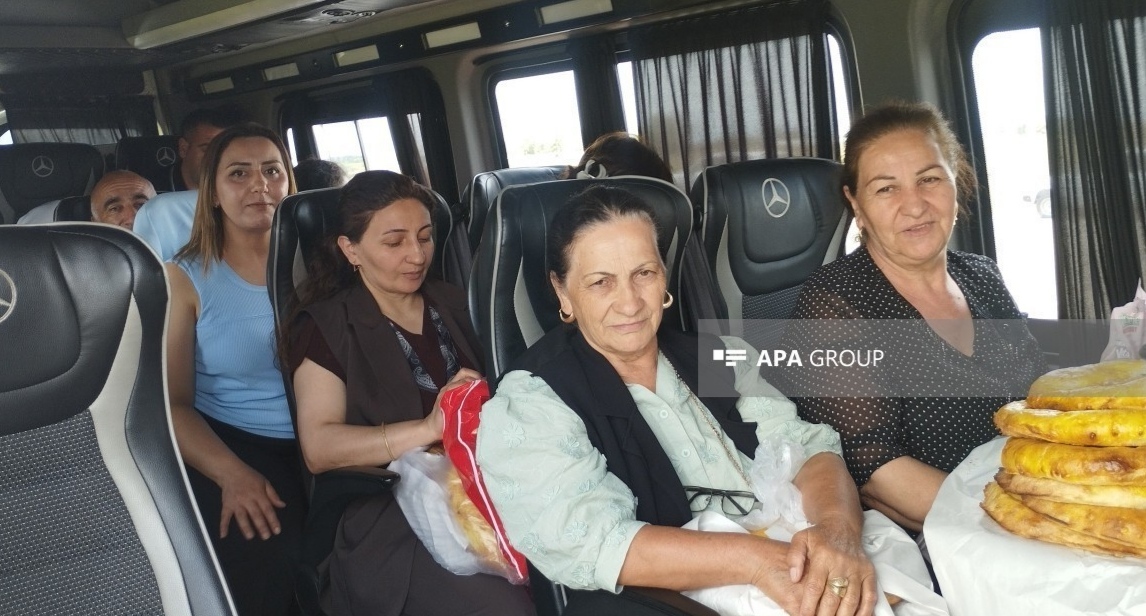
179 members of Azerbaijani families who fled during the Karabakh conflict have returned to six villages in the Khojaly region. They were given the keys to their homes.
As reported by the "Caucasian Knot," Azerbaijanis from Karabakh settlements were forced to flee their homes after the start of the First Karabakh War. The return of Azerbaijani displaced persons began after Azerbaijan took control of these territories. By March 11, 2026, 7,541 families (30,261 people) had returned to 41 settlements in the former Karabakh conflict zone.
In 2024, residents of the town of Khojaly (Armenian name – Ivanyan) were able to commemorate their fallen relatives on their native soil for the first time since 1992. On the night of February 26, 1992, during the Karabakh conflict, Armenian armed forces, with the assistance of CIS Joint Forces troops (who are believed to have acted without orders), stormed Khojaly, a town populated predominantly by Azerbaijanis. According to Azerbaijani authorities, 613 civilians were killed, according to the "Caucasian Knot" report "Khojaly Tragedy".
On May 16, more groups of former internally displaced persons arrived in the villages of the Khojaly region and were given keys to their homes, APA reports.
Ten families (33 people) were resettled to the village of Badara, ten families (60 people) to Tezebina, and nine families (33 people) to Khanabad. Another four families returned to the villages of Ballicha (22 people), Khanyurdu (18 people), and Dashbulag (13 people), the agency writes.
These families were temporarily resettled in various districts of the republic, primarily in dormitories, sanatoriums, and administrative buildings, Report writes.
The internally displaced persons living in a lyceum dormitory in Baku complained about living conditions. More than 30 families from the Zangilan and Jabrayil districts were resettled in the building. The "Caucasian Knot" published a photo report by Aziz Karimov, "A hostel for internally displaced persons from the Karabakh conflict zone in Baku."
The pace of resettlement is constrained by mine danger and a shortage of vacancies.
In November 2023, shortly after the end of hostilities, Azerbaijani authorities announced plans to return 34,500 families (140,000 people) to the former Karabakh conflict zone by the end of 2026. Despite the construction of roads, energy facilities, and housing, the pace of resettlement is constrained by mine danger, lack of jobs, and unresolved land use issues, analysts noted in April 2026.

In In the former Karabakh conflict zone, security forces, sappers, and local residents are periodically blown up by mines. The villages to which residents are returning have been cleared of mines, but outside populated areas, dangerous zones remain.
Azerbaijani residents who returned to Karabakh told the "Caucasian Knot" that they are settling down and finding work. Despite persistent problems with employment and infrastructure, displaced persons report improved living conditions.
Most, like me, have created livestock mini-farms.
For example, Rashid Aliyev, whose family returned to the village of Khydyrly in the Agdam region in the summer of 2025, said that his retired parents were provided with a separate two-room house, while he, his wife, and their three children were given a three-room house. "Each house was allocated a 12-hectare plot of land. Some planted flowers, others trees. But most, like me, created mini-farms for livestock. I built a barn and a chicken coop. I have four cows, a bull, a dozen rams, twenty chickens, ducks, geese, and turkeys. The conditions here are excellent for livestock farming," Aliyev said.
Earlier, Azerbaijani displaced persons complained about the difficulties of returning to Karabakh. In particular, they noted a shortage of jobs in Fuzuli. People are seeking opportunities to return to their homelands, but IDPs say property issues in the territories under Azerbaijani control have not yet been resolved.
Azerbaijani analysts interviewed by the "Caucasian Knot" noted that simply providing housing to returning IDPs is not enough; the authorities must create jobs and build infrastructure.
On September 19-20, 2023, Azerbaijan launched large-scale military operations and took control of Nagorno-Karabakh, which began a mass exodus of the Armenian population. By October 7, 2023, 100,632 IDPs from Nagorno-Karabakh had arrived in Armenia, and by September 2024, only 14 Armenians remained in the region. The "Caucasian Knot" has prepared a report "The Beginning and End of the Unrecognized Republic of Artsakh".
Translated automatically via OpenAI from https://www.kavkaz-uzel.eu/articles/423306




![Tumso Abdurakhmanov. Screenshot from video posted by Abu-Saddam Shishani [LIVE] http://www.youtube.com/watch?v=mIR3s7AB0Uw](/system/uploads/article_image/image/0001/18460/main_image_Tumso.jpg "Tumso Abdurakhmanov. Screenshot from video posted by Abu-Saddam Shishani [LIVE] http://www.youtube.com/watch?v=mIR3s7AB0Uw")