

Residents of Karaman-2 attributed the lack of settlement status to the authorities' inaction on pumping out water.
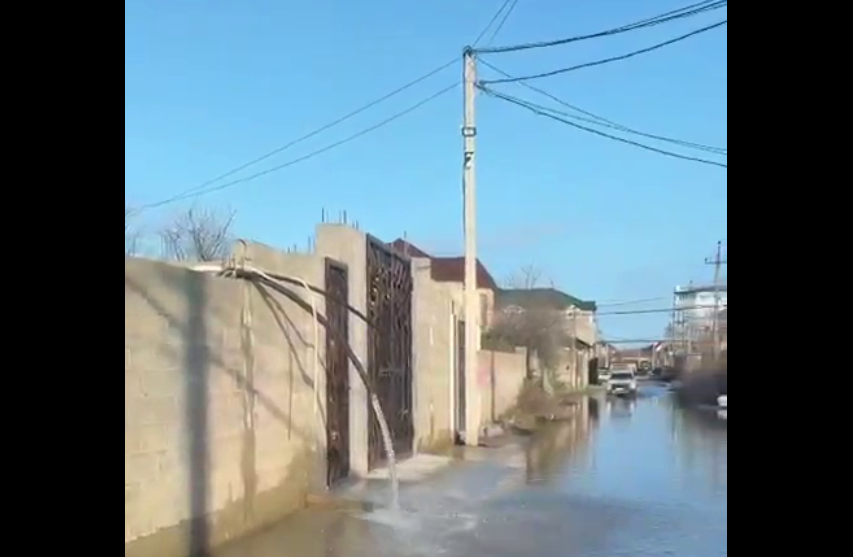
After residents of Karaman-2 appealed for water pumping, private individuals and businesses responded, but no support was received from the authorities. Residents attribute this to the fact that the village still lacks official status.
As reported by the "Caucasian Knot," on April 9, the state of emergency in Dagestan and Chechnya due to flooding was raised from regional to federal. The authors of the appeal to businesses and authorities asked for specialized equipment and pumps to be sent to the Karaman-2 microdistrict to pump out the water flooding the streets. According to them, only one pump truck visited the village during the flooding.
The author of the video, Mukhammad, told a "Caucasian Knot" correspondent that it was filmed on April 9. His nephew voiced the village's problem, and Muhammad's phone number was given, as he is one of the organizers of the restoration work in Karaman.
When asked if there had been any response to the video message, Muhammad replied that private individuals and businesses had responded with equipment and machinery. He added that the authorities had not yet provided similar support.
We rented a fire truck for three days and filled it with diesel fuel ourselves.
Earlier in his video message, he reported that since the first day of the flooding, only one fire truck with a pump had been in Karaman-2, which a village resident had taken charge of. "We rented a fire truck for three days and filled it with diesel fuel ourselves," Muhammad said.
He noted that the water still hasn't completely receded in the area where the video was filmed. "The drainage ditch where it could have been directed is filled in and, in some places, overgrown." "We've just hired a large excavator. Friends from Norilsk helped us out. We received 54,000 rubles from them today to pay for the excavator," Mukhammad said.
Karaman resident Ibrahim told a "Caucasian Knot" correspondent that the village has no sewer or storm drains.
"Every resident has a cesspool in their yard (a cesspool for collecting and temporarily storing wastewater in private homes not connected to the central sewer system. The wastewater accumulates and is then pumped out by a sewage truck - Caucasian Knot note). Sewage and stormwater have risen to the surface. "When it gets a little warmer, we're afraid an epidemic will break out, so we're trying to get rid of the accumulated water quickly," says a local resident.
According to him, there's a theory among residents that water was deliberately drained into Karaman from canals in fields near the villages of Semender and Krasnoarmeysk, as there was no flooding in Karaman during the torrential rains of April 28th and 29th.
On its Telegram channel, the "October Revolution Canal" branch of the Dagmeliovodkhoz denied the theory of "water discharge" toward the villages of Novokuli and Karaman.
"Technically, discharging water through the October Revolution Canal in this direction is impossible. Moreover, in the current situation, the branch's drainage system was used to drain water from flooded areas. Local residents had illegally dug trenches through which water from farmland was diverted into the K-4 collector for drainage. Representatives from the Main Directorate of the Ministry of Emergency Situations of Russia for the Republic of Dagestan, branch staff, and local administration officials visited the site to objectively assess the situation. "The fact has been confirmed: no water was discharged from the canal," the publication states.
A resident of the village, Isa, told a "Caucasian Knot" correspondent that the vegetable garden in his house was primarily damaged by flooding, and the basements were flooded. There is power and running water in the village now, but people don't drink tap water because it is of poor quality. They use bottled water, which volunteers bring in sufficient quantities.
He noted that Karaman is not officially part of any community; the land in the village has the status of a gardening non-profit partnership. "Because of this, the authorities are probably not paying attention to us," Isa believes.
"Karaman-2" is located on an area of approximately five square kilometers between the resettled villages of Chapayevo and Novokuli in the Novolaksky District. The area, which local residents Called Karaman-2, it is a gardening association named after Gadzhiali Daniyalov. It does not have official status as a municipality.
Local resident Abdul told a "Caucasian Knot" correspondent that the village of Karaman-2 is the closest to Makhachkala; there are also Karaman 5, 7, and others. Because the village does not have status, a state of emergency, as in Makhachkala, has not been declared here, he noted.
"Right now, mostly courtyards and streets are flooded; water has entered 30-40 houses. There is power, but the voltage is often only 120-125 volts. Today, volunteers pumped out the water with a motor pump, and others brought a lot of bottled water," he said. he.
Roads, electric poles, gas, sewerage, storm drains—people pay for everything themselves. There's no power for half a year, no water for the other half, but payments for services are made regularly, and status doesn't affect this.
"Karaman-2. Land without status. People don't have registration—only garden books. For years, there's been talk about incorporating them into Makhachkala, and that's where it ends. Roads, electric poles, gas, sewerage, storm drains—people pay for everything themselves. There's no power for half a year, no water for the other half, but payments for services are made regularly, and status doesn't affect this. And even in this situation, people aren't discouraged," he reported on the "Housing and Utilities Monitor" Telegram channel on April 3.
Earlier, lawyer Ali Aliyev, commenting on the flooding in the village of Novokuli in the Novolaksky District due to The lack of storm drains and clogged ditches, a lawyer told a "Caucasian Knot" correspondent, is responsible for flooding streets in populated areas. In this particular case, it is necessary to examine the documents of who is responsible for servicing a given village, since settlements resettled under a special program may have a special status, he clarified. To assess the damage, a flooding report must be drawn up, along with photos and video footage, and sent to the local administration. If there is no response, then the corresponding appeal is sent to the prosecutor's office, the lawyer said.
As "Caucasian Knot" reported, about 1.5 million residents are in the zone of devastating floods in Dagestan; a federal state of emergency has been in effect in the region since April 9.
Flooding caused by heavy rains has been ongoing in the North Caucasus since the end of March, and it has become one of the most destructive in recent years. The worst damage was in Dagestan and Chechnya, according to the Caucasian Knot report "Spring Flooding in the North Caucasus - 2026." Six people have died in the flooding in Dagestan.
Translated automatically via OpenAI from https://www.kavkaz-uzel.eu/articles/422372




![Tumso Abdurakhmanov. Screenshot from video posted by Abu-Saddam Shishani [LIVE] http://www.youtube.com/watch?v=mIR3s7AB0Uw](/system/uploads/article_image/image/0001/18460/main_image_Tumso.jpg "Tumso Abdurakhmanov. Screenshot from video posted by Abu-Saddam Shishani [LIVE] http://www.youtube.com/watch?v=mIR3s7AB0Uw")