


The memory of the victims of the Khojaly tragedy was honored in Azerbaijan.
On February 26, the anniversary of the Khojaly tragedy, residents of Azerbaijan honored the memory of the victims of the tragic events. A memorial complex was opened in the town of Khojaly. Thirty-four years later, the relatives of the victims continue to cherish their memory.
As reported by the "Caucasian Knot," Azerbaijan commemorates the victims of the Khojaly tragedy every February 26. On February 23 of this year, the country's Prosecutor General's Office reported that the remains of at least four people, including a child, had been discovered during excavations in Khojaly. The office explained that these are presumably the bodies of prisoners of war from the First Karabakh War. In 2024, for the first time since 1992, residents of Khojaly were able to commemorate their fallen relatives on their native soil.
On the night of February 25-26, 1992, during the armed conflict in Nagorno-Karabakh, Armenian armed forces, with the assistance of servicemen of the 366th Regiment of the CIS Joint Forces stationed in Stepanakert (who are believed to have participated in the fighting without orders from their command), stormed the town of Khojaly, populated predominantly by Azerbaijanis. Before coming under Armenian control, Khojaly was completely encircled for more than four months. Its residents experienced serious difficulties with medical care and food supplies. According to the Azerbaijani authorities, 613 civilians were killed, including 63 children, 106 women, and 70 elderly people, according to the report "Khojaly Tragedy", published on the "Caucasian Knot".
February 26 is marked in Azerbaijan as Khojaly Genocide Day. Since Khojaly returned to Azerbaijani control in September 2023, the mourning ceremony has been held in this city for the third year.
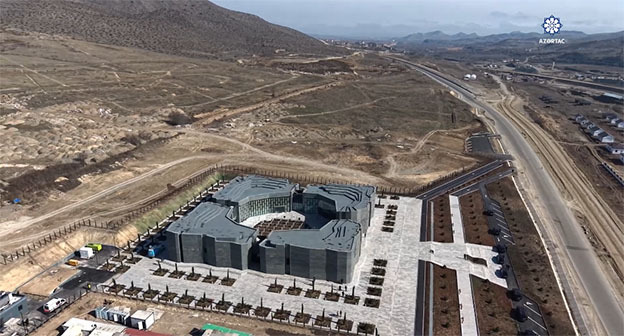
On the 34th anniversary of the tragic events, the opening ceremony of the Khojaly Genocide Memorial was held in the city of Khojaly on February 26, which was attended by Azerbaijani President Ilham Aliyev.
The memorial consists of four parts - monolithic blocks designed in the shape of symbolic hands seeking to protect the residents of Khojaly from genocide, the state news agency AZERTAC reports.
The memorial features exhibits about life in Khojaly before the tragedy, information about the victims, and the results of the international campaign "Justice for Khojaly!" A separate exhibit is dedicated to the 44-day war of 2020.
Firudin Aliyev, a resident of Khojaly who returned to the city, shared his memories of the events of 34 years ago.
"A week before the capture of Khojaly, I was wounded. This was my second gunshot wound. On the night of February 25-26, the offensive on Khojaly began. The defenders of Khojaly had only light firearms and were no match for the well-armed advancing forces, which had armored vehicles and artillery at their disposal. The screams of children and women in terror still ring in my ears. Residents, desperate to escape, began fleeing toward Aghdam. "Some people went towards the village of Ketik, others went through the mountains to the village of Abdal-Gyulably," Aliyev told a "Caucasian Knot" correspondent.
My brother's family also disappeared that night. There is still no news of his wife and two children.
According to him, some of the Khojaly residents were ambushed and shot at point-blank range as they passed Armenian villages. The wounded continued on their way, fell, and froze, the man continued.
"People lost relatives, many were never found. My brother's family also disappeared that night. There is still no news of his wife and two children. I reached the Gargar River wounded. "When my nephew tried to carry me, wounded, across the river on his back, we both fell and ended up in the icy water. For several days in the freezing cold, we hid in the forest, ate blackberry leaves and snow, and then with difficulty reached Aghdam," Aliyev continued.
Another Khojaly resident, Fitat Mamedova, recounts that a few days before the town was captured, her two-year-old child was killed during a rocket attack.
"That night, when the intense shelling began, we first hid in basements. "But when military vehicles entered Khojaly, people started fleeing towards Aghdam," Mamedova told a Caucasian Knot correspondent.
She noted that she was pregnant and found it difficult to ford the Gargar River and then continue through the forest and mountain.
I lost five relatives - a son, a husband, two brothers, and a nephew. And this wound will never heal.
Near the river, in the darkness of the night, she lost her brother and mother, who had managed to cross.
"Some of us, the residents, walked along the railway. When we reached Askeran, we encountered Armenians who shone flashlights to spot us and opened fire. We hid and then continued walking. At some point, I felt a warmth in my body. It turned out I had been hit by a bullet. But we kept going and finally reached the Garagaji cemetery on the outskirts of Aghdam. There, our soldiers met us and took us to Aghdam. The next day, my mother arrived too. On March 2, a KamAZ truck brought more than 80 bodies of the fallen. We went to the mosque, and among the dead were my husband, brother, and nephew. The body of another brother was brought on March 19. Thus, I lost five relatives – a son, a husband, two brothers, and a nephew. And this wound will never heal. The only consolation is that we were able to return to our native Khojaly. Every flower and every tree we plant today on this land where the blood of our martyrs was shed is a way to preserve their memory. We are consoled by the fact that we were able to regain our lost lands,” Mamedova said.
The State Committee for Refugees told the “Caucasian Knot” correspondent that about 4,000 people returned to the Khojaly region from the beginning of 2024 to February 2026.
Officials called for the events in Khojaly to be recognized as genocide
On the eve of the sad date, Azerbaijani Ombudsman Sabina Aliyeva called on international organizations and foreign countries to assess the events in Khojaly and officially recognize the mass killings as genocide.
"The brutal murder of the civilian population of the city of Khojaly due to "The massacre of Azerbaijanis on the basis of ethnicity, committed by the Armenian armed forces with the direct participation of the 366th Motorized Rifle Regiment of the USSR, became an integral part of the systemic and targeted policy of genocide conducted by Armenia at that time against Azerbaijanis," the Ombudsman said in a statement received by a Caucasian Knot correspondent from the press service of the Human Rights Commissioner's Office.
According to her, during the capture of the city, "the norms of international human rights law, international humanitarian law, including the provisions of the International Covenants on Civil and Political Rights and on Economic, Social and Cultural Rights, as well as the provisions of the International Conventions on the Elimination of All Forms of Racial Discrimination, Against Torture and Other Cruel, Inhuman or Degrading Treatment or Punishment, on the Rights of the Child, on the Prevention and Punishment of the Crime of Genocide," and other international legal acts were grossly violated.
During restoration and construction work in Khojaly, mass graves were discovered, and the remains of people killed under torture were found, identified, and interred, Aliyeva noted. "These facts are irrefutable and indisputable evidence of the Khojaly genocide and the grave war crimes committed," the Ombudsman emphasized.

She noted that a number of individuals accused of the Khojaly killings "are currently being prosecuted within the framework of the national legislation of the Republic of Azerbaijan, taking into account the norms of international law."
The statement by the Azerbaijani Ombudsman was sent to the UN Secretary-General, the UN Security Council, the UN High Commissioner for Human Rights, the UN High Commissioner for Refugees, the UN Human Rights Council, the heads of UNICEF, UNESCO, the European Union, the Council of Europe, the OSCE, the International and European Ombudsman Institutions, and other structures.
Azerbaijan's Foreign Minister Jeyhun Bayramov He noted that while advancing the peace process with Armenia, Azerbaijan “must not forget history.”
“Today we are talking about the peace process. The whole world has seen what decisive steps the Azerbaijani army has taken under the leadership of President Ilham Aliyev in this direction, restoring territorial integrity, ensuring our rights and historical justice. <...> At the same time, we must not forget our history. The processes taking place today are extremely important. As always, today the Azerbaijani people respectfully honor the memory of our martyrs,” haqqin.az quotes Bayramov as saying.
Traditionally, on the morning of February 26, thousands of Baku residents head to the “Mother’s Call” monument, erected in memory of the victims of the tragic events.
Commemorative events are also being held in other cities and regions of the country.
Translated automatically via OpenAI from https://www.kavkaz-uzel.eu/articles/421142


![Tumso Abdurakhmanov. Screenshot from video posted by Abu-Saddam Shishani [LIVE] http://www.youtube.com/watch?v=mIR3s7AB0Uw](/system/uploads/article_image/image/0001/18460/main_image_Tumso.jpg "Tumso Abdurakhmanov. Screenshot from video posted by Abu-Saddam Shishani [LIVE] http://www.youtube.com/watch?v=mIR3s7AB0Uw")