


Activists installed the 18th memorial plaque on Politkovskaya's house.
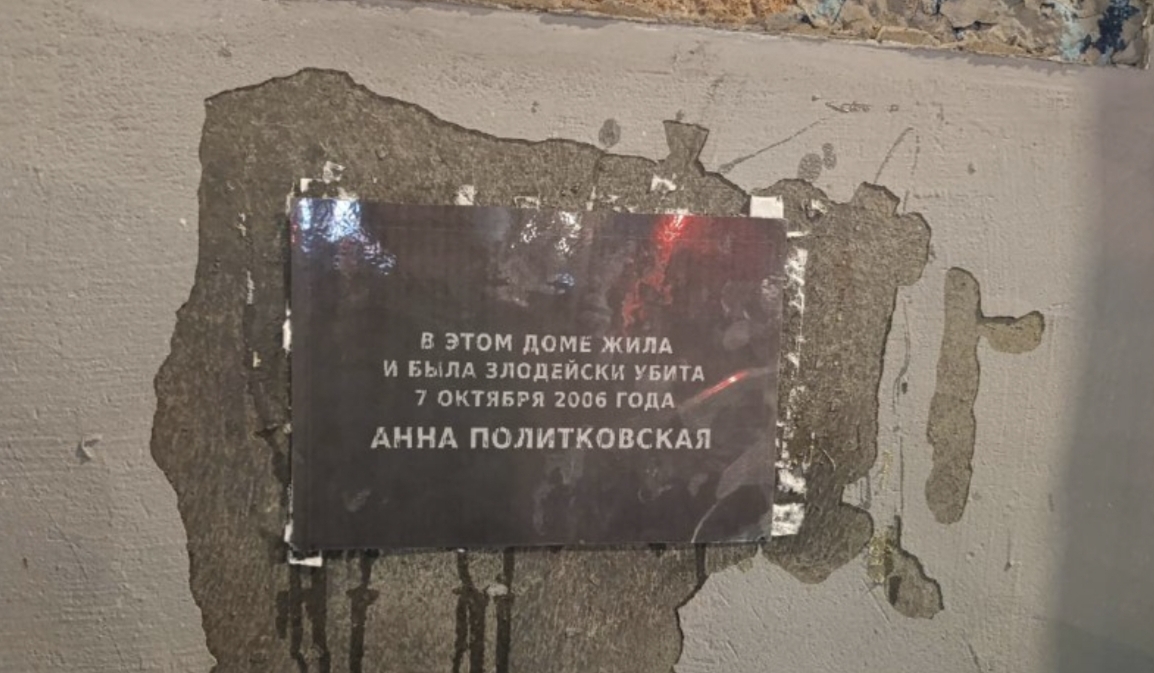
In the month since the destruction of the memorial plaque in honor of Anna Politkovskaya, activists have installed homemade memorial signs on the house of the murdered journalist at least 18 times.
As "Caucasian Knot" reported, on January 18, the memorial plaque, which had hung for almost 20 years on the wall of the house on Lesnaya Street in Moscow where Novaya Gazeta columnist Anna Politkovskaya lived and was shot, was smashed for the first time. Activists from the "Civil Initiative" placed a temporary plaque in its place, but on January 19 it was also destroyed. On the evening of February 17, activists installed the 17th homemade memorial plaque on the facade of Politkovskaya's house.
One of the plaques, installed by Yabloko party activists, hung for a week and a half, but was also destroyed on February 6. Afterward, the original text from the broken plaque ("Anna Politkovskaya lived in this house and was vilely murdered on October 7, 2006") was painted onto the facade by activists. Representatives of a far-right organization, designated as terrorist, claimed involvement in the destruction of the first plaque. The man who smashed the plaque was fined 1,000 rubles, but he denied any wrongdoing, claiming that the plaque "fell and broke on its own."
The seventeenth homemade plaque, installed by activists on the wall of Anna Politkovskaya's house in Moscow, hung in place for less than a day, like most of the previous ones. The plaque was still on the wall on the afternoon of February 18, but disappeared early in the evening, reports SOTAvision*.
A few hours later, activists re-attached a cardboard plaque to the wall in the same spot, bearing the text of the broken memorial plaque. This memorial sign, installed on the evening of February 18, is already the eighteenth, the publication notes.
Restoring the memorial for the ninth and eleventh times, activists attached a plaque near the house on Lesnaya with the text: "Here in 2026, neo-Nazis destroyed the memorial plaque to Anna Politkovskaya."
Temporary plaques and bouquets of flowers have been torn down and carried to the nearest trash bin for a month by 69-year-old Kadyrov fan Galina Shustova, a resident of the house on Lesnaya, who claims that the memorial plaque "has always bothered her, from the very day it appeared here," Victoria noted in an article for Novaya Gazeta on February 17. Artemyeva.
The return of Anna Politkovskaya's name to the daily agenda was inevitable, since "all of Politkovskaya's themes have returned," Artemyeva believes. "From war crimes, terrorist attacks, and torture of prisoners to refugee issues, the complete lack of rights for political prisoners, and all manner of possible emergencies. The difference, however, is that all of Russia has now become Chechnya," the article states.
Any civic statement, be it a plaque in memory of Anna Politkovskaya or a "Last Address" sign for a victim of Stalin's repressions, provokes active aggression among supporters of the government in Russia. Impunity encourages spontaneous acts of vandalism, committed even without direct orders from above, human rights activists and a journalist interviewed by the "Caucasian Knot" indicated.
Anna Politkovskaya, known for her articles on the war and human rights violations in Chechnya, was killed in Moscow on October 7, 2006. The court found that Lom-Ali Gaitukayev organized the murder, and he was sentenced to life imprisonment. Rustam Makhmudov was found to be the actual perpetrator, according to the "Caucasian Knot" report "The Murder of Anna Politkovskaya".
Anna Politkovskaya's Last Interview was given to a "Caucasian Knot" correspondent an hour and a half before her death. In this interview, the journalist commented on Ramzan Kadyrov's career prospects.
In 2025, on the 19th anniversary of Anna Politkovskaya's murder, residents of Moscow and St. Petersburg brought flowers to her grave, the Novaya Gazeta office, and the memorial to the victims of repression. Some of those convicted in the case of her murder have already been released, but the person who ordered it has not yet been convicted, Politkovskaya's colleagues recalled.
On the fifth anniversary of Politkovskaya's murder, journalists and human rights activists at a rally in Tbilisi highlighted her contribution to the fight for freedom of speech, demanding that those who ordered her murder be identified.
"Caucasian Knot" publishes materials dedicated to Politkovskaya on the thematic page "Politkovskaya and Estemirova," which also contains materials about her friend To Anna, journalist and human rights activist Natalia Estemirova, who was killed in 2009 and also worked on the problems of residents of Chechnya. We have updated the apps on Android and Android. href="https://apps.apple.com/ru/app/%D0%BA%D0%B0%D0%B2%D0%BA%D0%B0%D0%B7%D1%81%D0%BA%D0%B8%D0%B9-%D1%83%D0%B7%D0%B5%D0%BB/id1154933161">IOS! We would be grateful for criticism and ideas for development both in Google Play/App Store and on KU pages in social networks. Without installing a VPN, you can read us on Telegram (in Dagestan, Chechnya and Ingushetia - with VPN). Using a VPN, you can continue reading "Caucasian Knot" on the website as usual, and on social networks: Facebook**, Instagram**, "VKontakte", "Odnoklassniki" and X. You can watch the "Caucasian Knot" video on YouTube. Send messages to +49 157 72317856 on WhatsApp**, to the same number on Telegram, or write to @Caucasian_Knot.
* are listed as foreign agents.
** Meta (owner of Facebook, Instagram, and WhatsApp) is banned in Russia.
Translated automatically via OpenAI from https://www.kavkaz-uzel.eu/articles/420929


![Tumso Abdurakhmanov. Screenshot from video posted by Abu-Saddam Shishani [LIVE] http://www.youtube.com/watch?v=mIR3s7AB0Uw](/system/uploads/article_image/image/0001/18460/main_image_Tumso.jpg "Tumso Abdurakhmanov. Screenshot from video posted by Abu-Saddam Shishani [LIVE] http://www.youtube.com/watch?v=mIR3s7AB0Uw")