

The court refused to re-examine the translators in the Gribul and Zinovkina case.
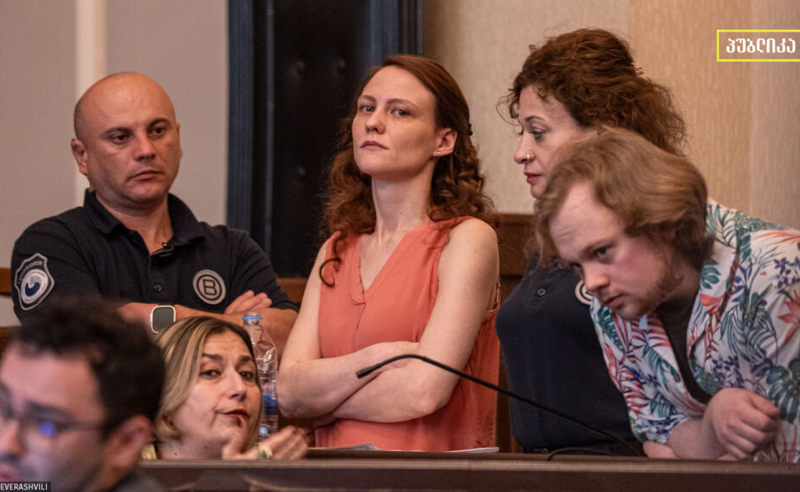
A panel of judges at the Court of Appeal rejected the defense's motion to re-examine witness interpreters in the case of Anastasia Zinovkina and Artem Gribul. The defense questioned the interpreters' professional integrity.
As reported by Kavkazsky Knot, in early February, Anton Chechin, Artem Gribul, and Sergei Kukharchuk, convicted in connection with participation in protests, were charged with using prohibited items in Gldani Prison. Under this charge, they face three to five years in prison. In late January, it was announced that convicted Georgian protester Anastasia Zinovkina had been transferred to a "closed-type" prison, with restrictions on her phone calls and visits. Her defense appealed the decision.
Russian citizens Artem Gribul and Anastasia Zinovkina, who participated in protests in Tbilisi, were arrested in December 2024 on drug trafficking charges. They claim evidence was planted against them and that security forces resorted to threats. On September 12, 2025, a Tbilisi court sentenced both to 8.5 years in prison. Anton Chechin, a protester, received the same sentence on a similar charge. Zinovkina said that on October 29, 2025, she did not receive any help from prison staff for eight hours, although she could not move because of back pain, and the doctor could only offer her "a stronger painkiller that the psychiatrist has." Zinovkina is provided with medical care in prison and does not need inpatient treatment, the Georgian Penitentiary Service stated in response to activists' demands for medical care. In November, the Court of Appeal began considering the complaints of the Russians. During the attacks, Anastasia Zinovkina, convicted in Georgia, cannot get out of bed, the fingers of her right hand and toes have become numb, her fiancé Artem Gribul said.
Today, the Tbilisi Court of Appeals heard a motion by the defense of Anastasia Zinovkina and Artem Gribul to re-examine their witness translators, Pirveli TV reports.
Anastasia Zinovkina participated in the hearing remotely from the Fifth Correctional Facility. Defense representatives suspect this may be due to her poor health. Artem Gribul was in the dock in the courtroom. His lawyer, Daria Samodurova, asked the panel of judges to question so-called neutral witnesses—translators for a contract company of the Georgian Ministry of Internal Affairs, Shorena Tabatadze and Anaida Safaryan.
According to Samodurova, Shorena Tabatadze participated in Zinovkina's personal interrogation, and Anastasia had questions for her, but the judge did not allow her to ask them and also rejected several questions that were important to the case. Moreover, the judge suspended Shorena Tabatadze from participating in the court hearing.
"Considering that a guilty verdict was handed down in the case of Anastasia Zinovkina and Artem Gribul, and Anaida Saparyan and Shorena Tabatadze were recognized as neutral witnesses, we believe that they should be questioned in the appellate court," Daria Samodurova stated at the hearing.
Since the case was heard in the court of first instance, the defense has argued that the translators involved in the case cannot be considered neutral witnesses, as they are close and involved in the work of the police and cannot be considered impartial observers of investigative actions, Publika reports.
According to Shota Tutberidze, Anastasia Zinovkina's lawyer, these "neutral witnesses" confirmed during the trial that another person arrested at pro-European rallies and The defendants accused of drug crimes (Anton Chechin's case) claim to have "close ties" to investigators, which, according to Shota Tutberidze, gives reason to believe they cannot be "neutral witnesses."
"These interpreters were not given the opportunity to repeat the same things at today's hearing. We have no illusions that these interpreters will appear in the appellate court or that they will suddenly tell the truth. However, we are confident that during the defense's cross-examination, the court would have certainly recorded these witnesses' "lies" and taken them into account when making its decision," stated Tutberidze's lawyer.
The prosecutor's office deemed the defense's motion unfounded. Prosecutor Nugzar Chitadze stated that the right of the defense was protected at all stages. He believes the defense asked exhaustive questions, and the judge's exclusion concerned questions that had already been posed by the defense and explained to the witness.
The judge concluded that, based on the case materials, there were no significant violations of the rules for questioning witnesses during the interrogation. Regarding the circumstances stated in the motion regarding the questions posed to the witness, the judge noted that this is subject to assessment and will be discussed during the review of the evidence. The court denied the defense's motion.
Caucasian Knot is posting materials about the recent municipal elections and protests by opposition supporters on the thematic page "Georgia: Elections Amid Protests".
Translated automatically via OpenAI from https://www.kavkaz-uzel.eu/articles/420720

![Tumso Abdurakhmanov. Screenshot from video posted by Abu-Saddam Shishani [LIVE] http://www.youtube.com/watch?v=mIR3s7AB0Uw](/system/uploads/article_image/image/0001/18460/main_image_Tumso.jpg "Tumso Abdurakhmanov. Screenshot from video posted by Abu-Saddam Shishani [LIVE] http://www.youtube.com/watch?v=mIR3s7AB0Uw")