

Alexander Lapshin complained about a series of detentions by Armenian security forces
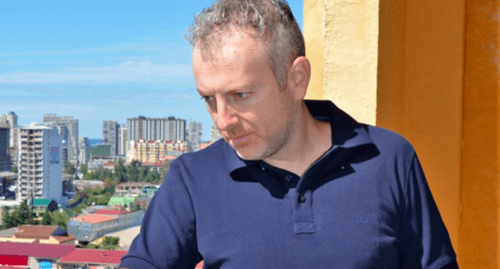
Blogger Alexander Lapshin claimed that Armenian security forces regularly detain him at the border because he is wanted in Belarus. An Armenian court dismissed Lapshin's lawsuit seeking an end to the detentions.
As reported by the " Caucasian Knot ," on September 11, 2017, the President of Azerbaijan pardoned blogger Alexander Lapshin, who was sentenced on July 20 of that year to three years in prison for illegally crossing the country's border. After his release, the blogger was hospitalized. According to Azerbaijani authorities, he attempted suicide; Lapshin himself called the incident an attempted murder. On September 14, 2017, the blogger flew to Israel .
Alexander Lapshin is a citizen of Russia, Ukraine, and Israel. Lapshin's criminal prosecution in Azerbaijan was initiated due to his visits to Nagorno-Karabakh, according to a report prepared by the "Caucasian Knot" entitled " From Belarus to an Azerbaijani Prison for a Post About Karabakh on Facebook ."*

An Armenian court has rejected Alexander Lapshin's claim to stop the prosecution at the request of Belarusian authorities, News.am reports.
"On February 6, 2026, the Armenian Administrative Court rejected my claim, which demanded that the persecution against me in Armenia be stopped at the request of Lukashenko's Belarus. Let me remind you that, for the purpose of legal terrorism (there's such a term), the Belarusian authorities placed me on the CIS wanted list for criticizing human rights violations in Belarus. Consequently, I was detained and held for hours at the police station every time I entered or exited Armenia," Lapshin said.
He described the Belarusian authorities' accusations as "absolutely completely fabricated and politically motivated." "Insulting the president of Belarus (whom I call a dictator), calling for a change of power in Belarus (I call for democratic elections), and so on," the publication quoted him as saying.
According to Lapshin, the judge "indicated that Belarus had sent a request to Armenia" for his arrest, but "did not send any documents proving my guilt."
The judge denied my claim in his decision.
"Nevertheless, the judge dismissed my claim in her decision, because, in her opinion, the Republic of Armenia's obligations to its CIS partners and the Chisinau Convention oblige it to detain wanted individuals, even if it is known that they are innocent, that they are being persecuted for their political activities, and that there are already decisions of the European Court against them," his words are quoted in the publication.
On October 11, 2021, the Grand Chamber of the ECHR rejected the Azerbaijani government's appeal to amend the court's decision of May 20 of that year, which found the Azerbaijani authorities guilty of the unlawful arrest, torture, and attempted murder of Alexander Lapshin in a Baku prison. The court ordered Baku to pay Lapshin €30,000 in compensation. In December 2022, the ECHR found Azerbaijan to be in non-compliance with the ruling in Alexander Lapshin's case.
Lapshin demanded that his persecution in Armenia be stopped, but, according to him, the judge indicated in the decision that "let them [the Belarusian authorities] lift the search, then they won't detain him in Armenia either."
He noted that the decision will be appealed to the Administrative Court of Appeals. "What awaits me the next time I visit Armenia? It's quite obvious, since the judge gave the green light to the Armenian National Security Service's border service to boldly act in the interests of the Republic of Belarus, allegedly because of 'obligations.' And that means I'll be detained again upon entry," Lapshin stated.
As a reminder, on October 21, 2024, security forces in Yerevan detained Russian citizen Roman Shklover, who is suspected in Russia of publicly justifying terrorism. In Armenia, this act is not a crime, and detention for political reasons is a gross violation of human rights, stated human rights activist Artur Sakunts. Shklover was released on the night of October 22 of that year .
However, Russian authorities issued an extradition request for Shklover. In August 2025, he stated that he did not wish to seek asylum in Armenia but could not leave until a decision on his extradition request was received. Human rights activists considered the chances of proving the political nature of Shklover's persecution high.
Foreign citizens can avoid extradition from Armenia if the risk of inhumane treatment and torture in the country where they are wanted is proven in court, human rights activists previously explained to the "Caucasian Knot," commenting on the detention of activists wanted on political charges.
Translated automatically via Google translate from https://www.kavkaz-uzel.eu/articles/420644


![Tumso Abdurakhmanov. Screenshot from video posted by Abu-Saddam Shishani [LIVE] http://www.youtube.com/watch?v=mIR3s7AB0Uw](/system/uploads/article_image/image/0001/18460/main_image_Tumso.jpg "Tumso Abdurakhmanov. Screenshot from video posted by Abu-Saddam Shishani [LIVE] http://www.youtube.com/watch?v=mIR3s7AB0Uw")