


A storm exposed a layer of fuel oil on the Bugay Spit.
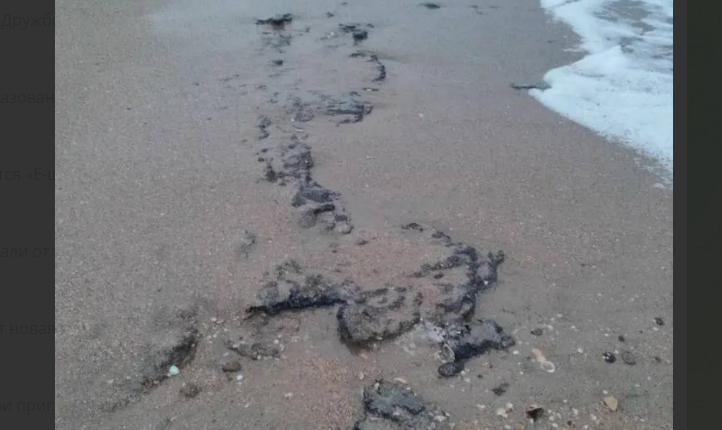
Waves eroded the shoreline on the Bugayskaya Spit, revealing a layer of fuel oil. Telegram users noted that the coastline needs a thorough cleanup, not just a show-stopper.
As reported by the "Caucasian Knot," on January 6, the Kuban operational headquarters reported on its participation in the net cleanup, noting that no new fuel oil spills had been detected. On January 7, volunteers found new and old fuel oil spills on Cape Tuzla.
Volunteers from the "Nets, Sieve, Shovel" headquarters discovered an old layer of fuel oil on the Bugayskaya Spit. "A wave washed away an old layer of fuel oil. In the area of the glamping site. Apparently, it will simply be washed out to sea in the next few days," they wrote on their Telegram channel on January 8.
This post received 46 comments on the headquarters' Telegram channel, which has 1,445 subscribers.
"This place seemed to have been sifted three times before," noted a user with the nickname Evil Well-wisher.
"Unfortunately, you can sow in different ways and at different depths. A cleaning system was needed, but there was chaos everywhere...," the authors of the post countered.
"At the 5.6 mark, there was an emergency training session for the Ministry of Emergency Situations. We were there for one day. At a depth of 40 centimeters, there was a layer 6-10 cm thick. From 1 "One and a half bags per square meter. Azamat, the eldest, said they were digging to that depth. But I didn't believe him. And there was no time to figure it out. We collected our 200 kg and left. How much is left? Tons. Is it still there? Is it already in the sea?" - wrote Vasiliy Vladimirovich Yegupets.
"It's even worse on Vityazevskaya. Everything's exposed there. Just like a year ago. Total déjà vu. And fresh sand is washing up on the dunes," wrote Anna.
"The beach from Vityazevo to Veselovka wasn't sown, and it should have been sifted, but alas. The wind blows the sand, exposing old deposits," added Blagamore.
Protective embankments hastily erected in Anapa in the fall of 2025 have been virtually destroyed by strong storms and are no longer functioning, volunteers noted. Bloggers countered that ramparts and nets are a good way to protect beaches from fuel oil if they are properly constructed and regularly maintained, noting that fuel oil spills were found behind the rampart after the storm. The nets left on the shore in Anapa after the storm destroyed the protective ramparts are no longer performing their function and need to be removed from the beaches before the next storm.
As a reminder, on December 15, 2024, two tankers carrying fuel oil sank in the Kerch Strait. A crew member of one of the tankers died as a result. In addition, an oil spill occurred, leading to catastrophic environmental consequences, according to the Caucasian Knot report "Fuel Oil Spill in the Kerch Strait".
Materials on the consequences of the fuel oil spill have been collected by the Caucasian Knot on the page "Eco-disaster in Kuban".
We have updated the apps for Android and IOS! We would be grateful for criticism and ideas for development both in Google Play/App Store and on KU pages in social networks. Without installing a VPN, you can read us on Telegram (in Dagestan, Chechnya and Ingushetia - with VPN). Using a VPN, you can continue reading "Caucasian Knot" on the website as usual, and on social networks: Facebook*, Instagram*, "VKontakte", "Odnoklassniki" and X. You can watch the "Caucasian Knot" video on YouTube. Send messages to +49 157 72317856 on WhatsApp*, to the same number on Telegram, or write to @Caucasian_Knot.
* Meta (owner of Facebook, Instagram, and WhatsApp) is banned in Russia.
Translated automatically via OpenAI from https://www.kavkaz-uzel.eu/articles/419773




![Tumso Abdurakhmanov. Screenshot from video posted by Abu-Saddam Shishani [LIVE] http://www.youtube.com/watch?v=mIR3s7AB0Uw](/system/uploads/article_image/image/0001/18460/main_image_Tumso.jpg "Tumso Abdurakhmanov. Screenshot from video posted by Abu-Saddam Shishani [LIVE] http://www.youtube.com/watch?v=mIR3s7AB0Uw")