


The destruction of monasteries in Karabakh has raised doubts among Azerbaijani analysts
Azerbaijani analysts have questioned the veracity of claims of vandalism at monasteries in Karabakh. They argue that Christian monuments in Azerbaijan are protected by the state.
As reported by the " Caucasian Knot ," a video of destruction inside the Yerits Mankants Monastery was published on Azerbaijani social media. Satellite images also show the destruction of the Holy Savior Monastery, both dating back to the 17th century. Historians have called on the international community to respond to the destruction of Armenian monuments in Karabakh.
Karabakh historians and activists have repeatedly reported the destruction of historical buildings and memorials in the region by Azerbaijani authorities. On May 12, 2024, the Foundation for the Study of Armenian Architecture reported , citing satellite images of the area, that the Surb Hambardzum Church in Berdzor had been completely destroyed. Baku countered that the church was built in the 1990s and therefore is not a historical monument protected by Azerbaijani law .
All historical monuments in Karabakh, including Christian ones, have been taken under state control, and none of them have been destroyed or damaged, said Faig Ismailov , an employee of the A. Bakikhanov Institute of History of the National Academy of Sciences of Azerbaijan (ANAS) and head of the public organization "Protection of Historical Monuments . "
According to him, Christian monuments in Karabakh and Eastern Zangezur have no connection with Armenians, but are the legacy of Caucasian Albania.
As the scholar emphasized, "the origins of Christianity in Azerbaijan date back to the early Middle Ages—the period of the state of Caucasian Albania." After the Arab Caliphate captured the territory of modern-day Azerbaijan, Christianity was gradually supplanted. However, the Khachen Principality, located in the territory of today's Lachin and Kelbajar districts, persisted until the 13th century. Even after the collapse of this state, Christian culture persisted in remote mountainous areas until the 18th century," he noted. Furthermore, according to the scholar, during the years when Karabakh was under Armenian control, a policy of Armenianization was pursued, Albanian monuments were remodeled in the Armenian style, and Armenian churches were built even in areas where Armenians had never lived, Ismailov explained.
According to him, one of the monuments that has undergone such Armenization was the monastery “Üç gənc” (“Three youths”), presented by Armenians as the monastery of the “Three infants” “Erits Mankants”.
"Armenian sources claim that this monument was built by the descendants of Khachen's ruler, Hasan Jalal, in 1691. A stone inscription above the door is cited as evidence. However, according to Armenian sources, the monument was "restored" in 2010. At that time, the temple's appearance was altered, and the inscription above the door was changed. On the other hand, Hasan Jalal was captured and killed by the Mongols in 1261. The claim that Hasan Jalal's descendants built the monastery approximately 400 years after his death appears unconvincing," the scholar said.
He also drew attention to the fact that the architectural structure of the “Üç gənc” (“Three youths”) monastery, located in the north of the Aghdere region, is identical to the Ganjasar ( Armenian name: Gandzasar, - note from the “Caucasian Knot” ) monastery, which was erected by order of the Khachen Albanian ruler Hasan Jalal in the 13th century.
As the scholar noted, the Üç gənc (Three Youths) Monastery was built as an integral part of the Ganjasar Monastery and operated under its management. Thus, the Üç gənc (Three Youths) Monastery joins the list of Caucasian Albanian monasteries in this region, along with Khudaveng, Urugveng, Ganjasar, and Kolatag, Ismailov continued.
"According to one of the few surviving sources about the construction of the monastery, 'Üç gənc' ('Three Youths'), the temple's name is associated with three young monks sent from Ganjasar to oversee its construction. After the monastery's completion, the young monks remained here to live until their deaths, and after their deaths, all three were buried on its grounds," Ismailov noted.
This monastery is the most striking example of monasteries built in the late Middle Ages in the Karabakh region.
"The monastery building is constructed on a rectangular plan from hewn and polished yellow-white local basalt stones. An ancient cemetery is located around the protective walls of the monastery complex," he said.
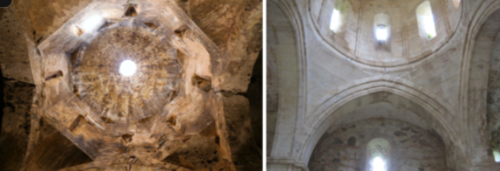 According to him, in 2010, when the territory was under the control of Armenian forces, illegal interventions were carried out on the monument's architectural appearance under the guise of "restoration." "Specifically, the interior of the dome was crudely altered, a cross was installed on the façade, and the stone inscription above the entrance door was replaced with a new one. Afterward, the area was abandoned by the 'restorers,'" the scholar continued.
In the monastery's original interior, the dome was constructed with Oghuz (Turkic) elements and was shaped like an eight-pointed star, he noted. "For this reason, the Armenian 'restorers' converted the octagonal shape into an oval," the scholar explained.
According to Ismailov, Turkic elements were characteristic of all the churches and monasteries of the region, and this was due to the fact that Hasan Jalal remained faithful to his roots, calling himself an ishkhan—a title borne by the rulers of early Turkic states.
The scholar noted that when the territory of Karabakh was under Armenian control, changes were made to the architectural appearance of other historical monuments. For example, the monasteries of Khudaveng ( the Armenian name Dadivank, - ed. "Caucasian Knot" ), Ganjasar ( the Armenian name Gandzasar, - ed. "Caucasian Knot" ), and Amaras, which are a legacy of Albanian Christian culture, were reconstructed. However, their external appearance was altered and remodeled to match the style of Armenian Christian buildings, which is easily proven by comparing photographs before and after reconstruction.
As the scientist emphasized, “the reconstruction of the monasteries was carried out in violation of the 1954 Hague Convention for the Protection of Cultural Property in the Event of Armed Conflict, which prohibits damage, destruction, or alteration of the appearance of cultural monuments by an occupying power.”
Ismailov doubts the veracity of reports of any deliberate damage to Christian monuments, let alone destruction, since Azerbaijan considers them part of its history.
He emphasized that all monuments, regardless of their religious nature, are protected by the state.
According to Ismailov, there are a total of 2,645 monuments in Karabakh and Eastern Zangezur, including 1,832 architectural, 749 archaeological, and 64 monumental sculptures. He adds that half of these monuments date back to the Christian and pre-Christian periods.
According to analyst Togrul Juvarli , a member of the Azerbaijani National Public Committee on European Integration, periodic reports of alleged damage to "Armenian Christian monuments" in Karabakh have a political motive.
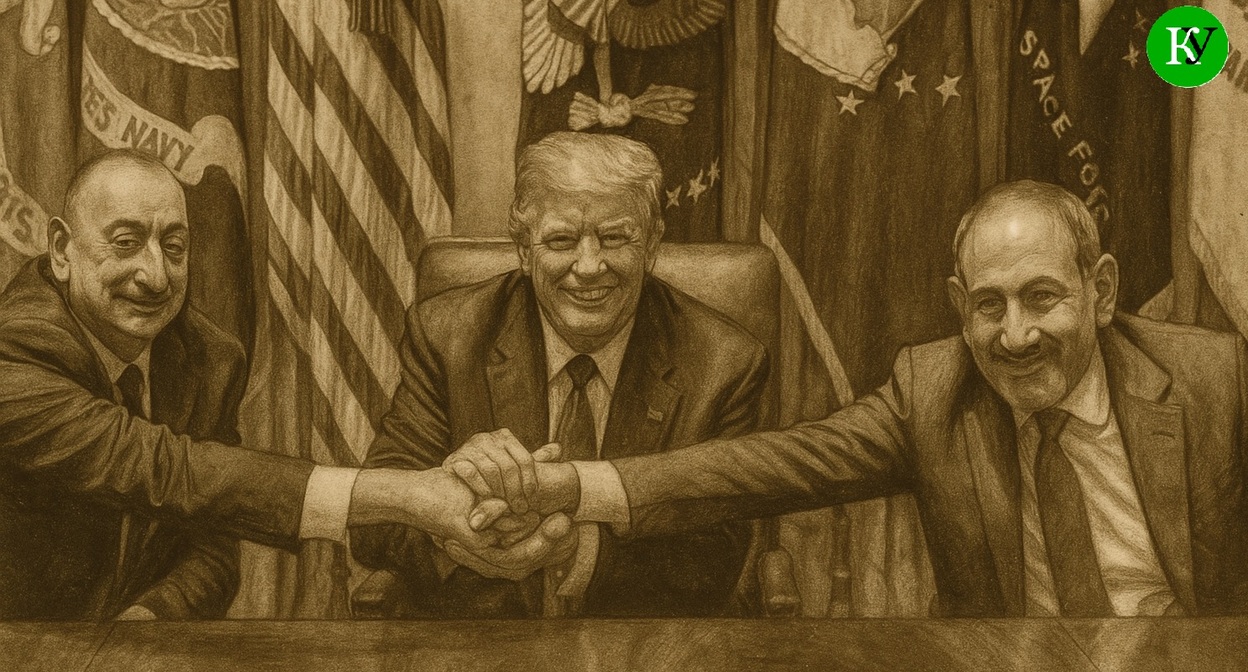
"This is aimed at maintaining international attention to the 'Karabakh issue,' which, amid numerous heated conflicts around the world, has disappeared from the global agenda, especially after the leaders of Azerbaijan and Armenia initialed a peace treaty in Washington in August of this year," Juvarly told a Caucasian Knot correspondent.
He questioned the veracity of the images of "destruction" and "damage" to monuments.
"In today's world, when artificial intelligence can generate anything, we need to be very careful with things like this," Juvarly said.
According to him, all monuments in the liberated territories are under state protection.
"I recently visited the region myself and had the opportunity to inspect many monuments, including a number of churches and monasteries, and I did not notice any 'fresh' destruction or damage," Juvarly said.
Azerbaijan, which positions itself as a multicultural state, has no need for the destruction of monuments related to Armenians, especially now that Baku is promoting a peace agenda.
He noted that many monasteries are located in the Agdere region, where very few people have returned and the territory is under the control of security forces.
"Azerbaijan, which positions itself as a multicultural state, has no need to destroy monuments related to Armenians, especially now that Baku is promoting a peace agenda and has already begun allowing cargo to Armenia and even fuel exports. Secondly, Azerbaijan considers Christian monuments part of its history – the legacy of Caucasian Albania. Along with Albanian monuments from the early and late Middle Ages, Azerbaijan also protects Armenian churches from the 19th century. In Baku, an Armenian church in the city center was restored 15 years ago. After the liberation of Shusha in 2020, an Armenian church, accidentally damaged during the fighting during the 44-day war, was repaired. The church in Khankendi is protected by the state," Juvarli said.
According to religious affairs expert and journalist Tofig Turkel ( who worked for the now-defunct Turan news agency - Caucasian Knot note ), the Karabakh conflict has caused the most damage to Muslim religious monuments.
“Of the 67 mosques in Karabakh, 65 were destroyed or partially destroyed and desecrated,” Turkel told a “Caucasian Knot” correspondent.
However, he said, Azerbaijan took historical and religious monuments, including Christian ones, under protection immediately after the end of military operations and in 2020 and 2023.
On September 19-20, 2023, Azerbaijan conducted large-scale military operations in Karabakh, after which an agreement was reached to cease hostilities and disarm the Karabakh Defense Army. On January 1, 2024, the Nagorno-Karabakh Republic ceased to exist in accordance with the decree of its last president, Samvel Shahramanyan . The "Caucasian Knot" has prepared a report entitled " The Beginning and End of the Unrecognized Republic of Artsakh ."
According to him, more than 700 monuments have been taken under protection, and restoration of some of them has begun and even already been completed.
Turkel also noted the increased attention in the West to this issue, and in particular to the preservation of Christian heritage.
"However, Azerbaijan already cares about Christian monuments, as they are part of the historical heritage of Caucasian Albania. On the other hand, appeals from foreign NGOs, research centers, and individuals cannot be prescriptive or didactic. Azerbaijan is a sovereign country and acts within the framework of its laws and obligations under international conventions," Turkel said.
He emphasized that authoritative international organizations such as the UN, OSCE, and the Council of Europe have not made any claims regarding the safety of Christian monuments.
We've updated our Android and iOS apps ! We welcome your feedback and development ideas both on Google Play/App Store and on KU's social media pages. You can read us on Telegram without a VPN (with a VPN in Dagestan, Chechnya, and Ingushetia). Using a VPN, you can continue reading "Caucasian Knot" on the website as usual and on social media: Facebook *, Instagram *, VKontakte , Odnoklassniki , and X. You can watch "Caucasian Knot" videos on YouTube . Send messages to +49 157 72317856 on WhatsApp*, to the same number on Telegram, or write to @Caucasian_Knot.
* Meta (which owns Facebook, Instagram, and WhatsApp) is banned in Russia.
Source: https://www.kavkaz-uzel.eu/articles/419091

![Tumso Abdurakhmanov. Screenshot from video posted by Abu-Saddam Shishani [LIVE] http://www.youtube.com/watch?v=mIR3s7AB0Uw](/system/uploads/article_image/image/0001/18460/main_image_Tumso.jpg "Tumso Abdurakhmanov. Screenshot from video posted by Abu-Saddam Shishani [LIVE] http://www.youtube.com/watch?v=mIR3s7AB0Uw")