


Dress code issues have highlighted other women's rights issues in Chechnya.
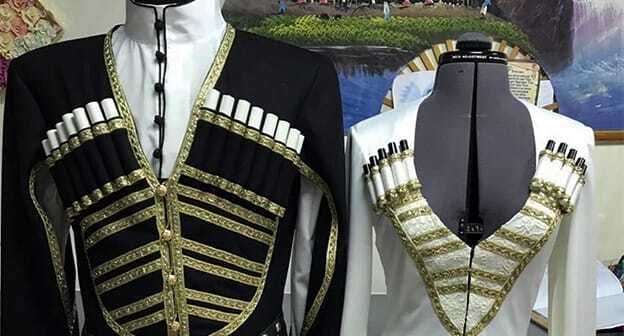
The ban on masculine attributes in women's clothing, as recalled by the Chechen Ministry of Culture, meets public demand, but the artificial struggle for "traditional values" and official control over all aspects of people's lives worsen the situation for women.
As reported by the "Caucasian Knot," on November 14, the Chechen Ministry of Culture warned designers about the ban on using elements in women's clothing that historically belonged to men's national costume. As an example, the ministry cited gazyrs—slots for cartridges sewn onto the chest, which, having lost their original practical meaning, have become "a sign of courage, honor, and protective spirit." The use of these elements in women's clothing is perceived as "an infringement on male symbolism and a violation of centuries-old traditions," the ministry noted.
The demand for control over women's dress code, not only in the civil service but also in everyday life, could well come from the republic's population, since Chechen society is generally conservative, according to political scientist Ruslan Kutayev*. According to him, women wearing trousers is also frowned upon in the republic; however, the political scientist was unable to say whether there is currently an outright ban on pantsuits for women in Chechen government agencies.
"Society, which adheres to the morality of the Chechen people, does not like it when women wear trousers, regardless of whether they are at work or at home. I have never seen any women wearing gazyrs anywhere; that, of course, is nonsense." Chechen women didn't wear gazyrs before: gazyrs are a device for storing gunpowder, not just for showing off or being fashionable. It was a necessity to have gunpowder on hand, and it was only needed by those fighting and actively defending themselves," Kutayev* told the "Caucasian Knot." The specific dress code in effect in Chechnya applies not only to gazyrs, but its enforcement isn't an issue requiring special oversight—"until the Soviet regime began imposing a dress code that was unconventional to Islam," noted a human rights activist familiar with the situation in the republic. "In my opinion, it's wrong to mix gender attire. I don't think this has anything to do with social control," he told a "Caucasian Knot" correspondent on condition of anonymity.
Any traditional Caucasian culture clearly divides clothing and its attributes into male and female, noted a Russian Caucasus scholar who wished to remain anonymous.
“Gazyrs appeared quite late; they didn't exist before the advent of firearms and the need to carry ready-made gunpowder. But gazyrs are undoubtedly an element of men's attire, because men fought, and firearms could be wielded by men. For a woman to use firearms, something extraordinary had to happen,” he told a “Caucasian Knot” correspondent.
Other elements of traditional clothing also differed, even if their function in both men's and women's attire was similar. “A men's belt and a women's belt are completely distinct from one another: although functionally they are both belts, there are expressive elements that are meant to emphasize: this is a man's belt, and this is a woman's belt, respectively. Or, for example, the fasteners present in both men's and women's clothing are very noticeably different; you'll never confuse them. Even if you take shalwar kameez, pants—women's or men's—in some cultures, they are also very clearly distinguished by gender, naturally," he said.
At the same time, the Caucasus expert questioned the validity of criticism of modern designer clothing based on certain attributes. "The gazyrs, as far as I understand, on modern clothing are not real, but painted on. It's unclear what all the fuss is about. The presence of painted gazyrs doesn't mean a woman would use them for gunpowder. However, gazyrs didn't serve this purpose for long on men's clothing either. That type of weapon was inconvenient and was quickly replaced by other types of firearms," he explained.
According to the expert, in traditional society, there were no specially appointed guardians of the dress code. "In traditional societies, there are no special people who monitor clothing. 'What will people say?' is an important argument for someone from a traditional society. People can judge, and this is bad for someone from a traditional society. In general, society itself acts as a kind of subject, so to speak, for evaluating people's behavior," the Caucasus expert pointed out.
Svetlana Gannushkina, Chair of the Civic Assistance Committee*, considers direct interference by officials in women's dress code issues absurd and believes the analogy with the Taliban's policy in Afghanistan is justified. "Both seek to interfere in every aspect of private life; this is totalitarianism. This is worse than discrimination: what women wear is no one's business. Trousers have long been considered entirely feminine clothing; in the East, women have always worn trousers," she told a "Caucasian Knot" correspondent.
The true values of Chechen society, according to the human rights activist, lie in a different realm—although they sometimes lead to legal problems. "This is respect for people in need of help and support, especially the elderly, and also a ban on interference in family relationships - no outsider can make comments to members of another family. But this also has negative aspects in cases of domestic violence: we have to help women who want to work, study, and decide for themselves when and whom to marry, how to raise their children - that is, they want to be full members of society. The tradition of taking children from their mothers during divorce cannot but worry women. We are seeing how women, having experienced the dictatorship of their mothers-in-law in their youth, become tyrants to their daughters-in-law," Gannushkina* said.
There is an element of discrimination in the actions of the Chechen authorities in the fight for traditional values, since they mostly affect women, says Saida Sirazhudinova, President of the Center for the Study of Global Issues of Our Time and Regional Problems "Caucasus. World. Development."
"It is being done "There's a paradoxical emphasis on certain details, but the essence of traditions is lost; superficial control masks deep-seated differences. Interference with clothing, style, and fashion is superficial and populist, meaningless, but it demonstrates control over the population. Although women aren't the only ones suffering from attempts to impose dictatorial control, they are subjected to the most intense pressure," Sirazhudinova stated. A policy of restricting women's rights, similar to that of the Taliban, has long been imposed in Chechnya, but for now, despite a number of pressing issues, the situation with women's rights in the republic is not as poor as in Afghanistan.
"In Chechnya, girls whose families allow it study, obtain high positions, and aren't so isolated. Although, if the crackdown on women's rights continues, anything is possible over time. But there's also a countermovement, with women trying to defend their rights. The rally in Nice is a clear example of this; although women received threats afterward, they showed their voice and expressed their indignation," Sirazhudinova emphasized.
She added that the region has many wonderful values and traditions that create uniqueness and are essential to its people, but the pressure and prohibitions imposed by neotraditionalist policies only complicate the situation. "If people are given a choice, they will choose the optimal path and preserve traditions as something beautiful, bright, and unique, not as something associated with pressure and violence. Lately, they've been constantly thinking about their own safety, and that's scary," Sirazhudinova explained.
We've updated the apps for Android and IOS! We would be grateful for criticism and ideas for development both in Google Play/App Store and on KU pages in social networks. Without installing a VPN, you can read us on Telegram (in Dagestan, Chechnya and Ingushetia - with VPN). Using a VPN, you can continue reading "Caucasian Knot" on the website as usual, and on social networks: Facebook**, Instagram**, "VKontakte", "Odnoklassniki" and X. You can watch the "Caucasian Knot" video on YouTube. Send messages to +49 157 72317856 on WhatsApp**, to the same number on Telegram, or write to @Caucasian_Knot.
* are listed as foreign agents.
** Meta (owner of Facebook, Instagram, and WhatsApp) is banned in Russia.
Translated automatically via OpenAI from https://www.kavkaz-uzel.eu/articles/417309

![Tumso Abdurakhmanov. Screenshot from video posted by Abu-Saddam Shishani [LIVE] http://www.youtube.com/watch?v=mIR3s7AB0Uw](/system/uploads/article_image/image/0001/18460/main_image_Tumso.jpg "Tumso Abdurakhmanov. Screenshot from video posted by Abu-Saddam Shishani [LIVE] http://www.youtube.com/watch?v=mIR3s7AB0Uw")