

Maykop
Capital of Adygeya, 1,669 km south of Moscow. Located on the right bank of the Belaya River (tributary of the Kuban), on the Tuapse - Ust-Labinsk motorway. Railway station in the branch of Hadzhok - Belorechenskaya in the Armavir - Tuapse line. Motor road junction (to Tuapse, Ust-Labinsk, Armavir, Labinsk, etc.). Population (1992 est.) 152.5 thousand, (1897 est.) 34.2 thousand, (1926 est.) 53 thousand, (1939 est.) 56 thousand, (1959 est.) 82.2 thousand, (1970 est.) 110 thousand, (1979 est.) 127.8 thousand.
Maykop was founded in 1857 on the right steep bank of the Belaya, in the land of the Adygs, as a Russian fortress surrounded by a ditch and a high wall. In 1858-1863, at the final stage of the Caucasian war, it was an important strategic point in conquest of Cherkessia: ways of all military units of Russia, going from central provinces to Transkubania, converged here. Uyezd (canton) city since 1870. Military management was abolished in 1871, and the city status was acquired in 1878; which enabled commercial and industrial development of the city. In the late 19th century, there were 5 Orthodox churches, a synagogue, a municipal school, a 3-class municipal college, 2 primary male and female schools, 2 private schools, 2 chemists'. The city had 121 stone houses, 5,340 wooden ones; 112 factories, plants and industrial establishments, including a winery, 2 soap factories, 3 skinneries, 13 brickworks, a tobacco factory, 3 breweries, an iron foundry, 24 creameries, 8 potteries, 50 barrel factories, 6 water mills; cattle breeding, tobacco-cultivation.
In 1897, the archaeologist N.I. Veselovsky explored the burial mound of Voshada, where the richest burial of a patrimonial leader was found. It dated back to the archaeological culture of the second half of the 3rd millennium B.C. and was widespread in the foothill part of the North Caucasus from Kuban region to Chechnya. Later, it was referred to as the Maykop culture.
In 1911, Academician I.M. Gubkin discovered oil fields in the area of Maykop, which was important for development of the city economy. Maykop has been the capital of Adygeya since 1936. During the Great Patriotic War of 1941-1945, occupation (from August 10, 1942 to January 29, 1943) by Nazi troops caused huge damage to the city.
By the beginning of the 1990s, Maykop had engineering plants and metal-cutting enterprises (a machine tool plant, an engineering plant, a reducer works, Stankonormal, Tochradiomash, Promsvyaz), furniture and woodworking industry (PО Druzhba), food industry (meat-processing plants, a dairy factory, a sweating factory, etc.), light industry (a clothes factory, a shoe factory, a cordage factory, etc.); production of building materials. State single-area power station.
The city has a teacher-training institute and an institute of the Adygey language, history, economy and literature. There are two drama theatres in the city, an Adygey and a Russian ones. Philharmonic society. A museum of history and local lore and the North Caucasian branch of the State museum of Oriental peoples' art.
The city centre is formed by Ploshchad Lenina with a monument to V.I. Lenin (1959, sculptor M.G. Manizer, architect I.Y. Rozhin) and Ploshchad Druzhby with the monument of Druzhba (Friendship) (1968, sculptors M.G. and О.М. Manizers, architect Rozhin). The largest public buildings are the Adygeya Hotel, the House of Communication (both built in 1956), the Oktyabr cinema (1961, architect Y.F. Kaverin), the House of Justice (1966, architect I.V. Yaroshevsky), a municipal art school (1972), the House of Adygey Government (1988, architect О.N. Kobzar), a museum of local lore (1992, architect A.D. Odishariya). The central memorial (1927, sculptor Y.N. Kozlovsky; renovated under the project of the sculptor N.N. Nikolenko), a memorial plaque (1961) and a monument (1971, architect А. Shikoyan) commemorating diggings of the Voshada burial mound; a monument to the Grieving Mother, commemorating 33 mortar gunners who perished during the Great Patriotic War (1978, architect Shikoyan). There is a park of culture and rest along the Belaya River.

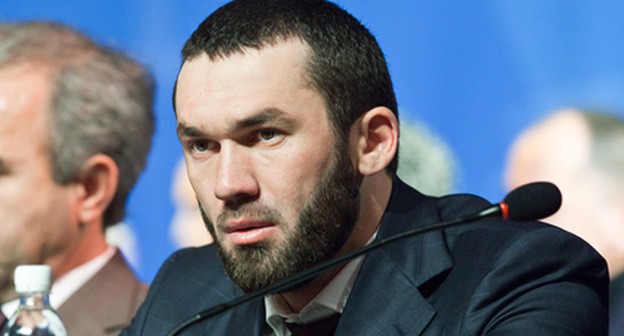
![Tumso Abdurakhmanov. Screenshot from video posted by Abu-Saddam Shishani [LIVE] http://www.youtube.com/watch?v=mIR3s7AB0Uw](/system/uploads/article_image/image/0001/18460/main_image_Tumso.jpg "Tumso Abdurakhmanov. Screenshot from video posted by Abu-Saddam Shishani [LIVE] http://www.youtube.com/watch?v=mIR3s7AB0Uw")