

The EU Council approved the cancellation of tariffs on most goods from Armenia.
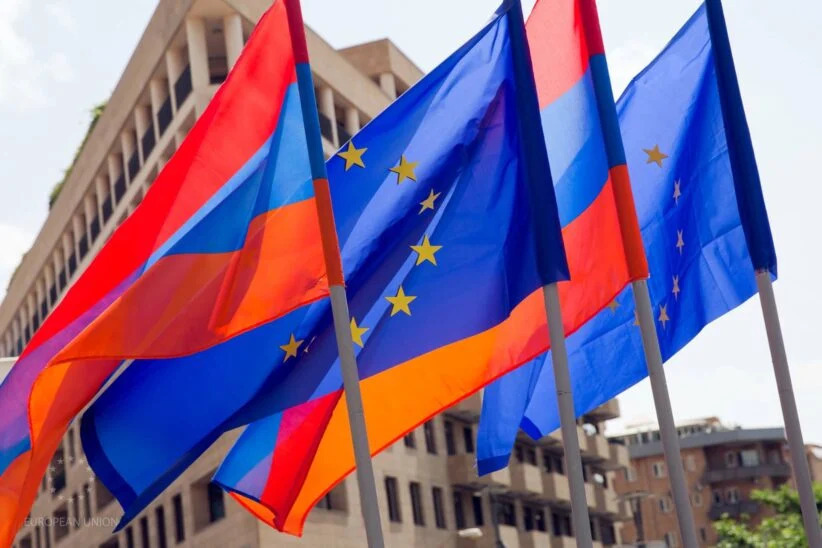
The Council of the European Union approved the suspension of tariffs on 80% of goods from Armenia for a period of two years. It is noted that the measure is intended to "support the economy of Armenia after the trade restrictions imposed by Russia."
As reported by "Caucasian Knot", on September 1, Vladimir Putin, during negotiations with Armenian Prime Minister Nikol Pashinyan at the SCO summit in Kyrgyzstan, urged the Armenian Prime Minister to make a decision on the issue of Armenia's accession to the EU as soon as possible. In response, Pashinyan stated that the right moment for this has not yet arrived.
A referendum on Armenia's accession to the EU will take place after the submission of the relevant application and the formation of a roadmap, Prime Minister Nikol Pashinyan stated earlier. He also announced plans to achieve visa-free travel with the European Union within three years and to refrain from active participation in the CSTO for the next five years.
The EU Council agreed to introduce temporary measures to liberalize trade in Armenian products to support the economy of Armenia after the trade restrictions recently imposed by Russia. The measures, which are set for two years from the date the regulation comes into force, will allow for the liberalization of about 80% of Armenian exports to the European Union, according to a statement from the EU Council on its official website.
The regulation provides for a temporary suspension of import duties for a wide range of Armenian products, including certain types of agricultural goods that are subject to tariff quotas. Protective mechanisms are also provided in case the increase in imports of Armenian products negatively affects producers in the EU.

According to the EU Council, the preferential regime will cover almost 99% of Armenian exports of fresh fruits, vegetables, and plants that were directed to Russia, as well as over 91% of exports of beverages and alcohol.
"Europe supports Armenia and its people, who have chosen a clear path of reforms and closer cooperation with the European Union. Today's decision sends a clear signal: faced with economic coercion, the EU will respond. We will create new opportunities and support our partners," said Ireland's Minister of Foreign Affairs and Trade, Helen McEntee.
The Council explained that the proposed regulation is intended to support Armenia after the trade restrictions imposed by Russia, which disrupted Armenian exports and transit routes. Another goal of the measures is to strengthen trade relations between Armenia and the EU in accordance with the Comprehensive and Enhanced Partnership Agreement (CEPA).
This agreement is accompanied by certain conditions and includes protective measures for the EU market. The conditions remain contingent on Armenia's compliance with existing rules of origin, participation in administrative cooperation with the EU, refraining from introducing new trade restrictions on imports from the EU, and respecting the core elements of CEPA, including democratic principles, the rule of law, and human rights.
The Council expects that the European Parliament will approve these measures at a plenary session in September. The regulation will come into force the day after its publication in the Official Journal of the European Union, according to the statement.
It should be noted that the Rosselkhoznadzor introduced temporary restrictions on the import of flowers from Armenia starting May 22, 2026, and from May 30, on fresh tomatoes, cucumbers, peppers, greens, and strawberries. Additionally, the import of all batches of Armenian mineral water "Jermuk" and several cognacs and wines into Russia was halted, and the import of fish from Armenia was significantly restricted.
From June 2, the Rosselkhoznadzor expanded the ban on fresh grapes and stone fruits, including cherries and sweet cherries, and from June 3 - on potatoes, eggplants, as well as pome fruits and dried fruits. On June 19, the European Commission allocated Armenia 34 million euros to mitigate the effects of Russia's trade restrictions on the country's private sector.
On July 24, the Rosselkhoznadzor announced a new ban - on the import of dairy products from Armenia. In response, on August 4, Armenia banned the import of tomato paste amid export restrictions from Russia. In particular, the import of tomato paste was restricted from the countries of the Eurasian Economic Union.
"Caucasian Knot" also reported that in mid-August, the Armenian government approved a project for subsidy payments amounting to 5.365 billion drams (about 14.7 million dollars) to entrepreneurs exporting agricultural products to the markets of the EU, the UK, and Canada.
Translated automatically via OpenAI from https://www.kavkaz-uzel.eu/articles/426298

![Tumso Abdurakhmanov. Screenshot from video posted by Abu-Saddam Shishani [LIVE] http://www.youtube.com/watch?v=mIR3s7AB0Uw](/system/uploads/article_image/image/0001/18460/main_image_Tumso.jpg "Tumso Abdurakhmanov. Screenshot from video posted by Abu-Saddam Shishani [LIVE] http://www.youtube.com/watch?v=mIR3s7AB0Uw")